


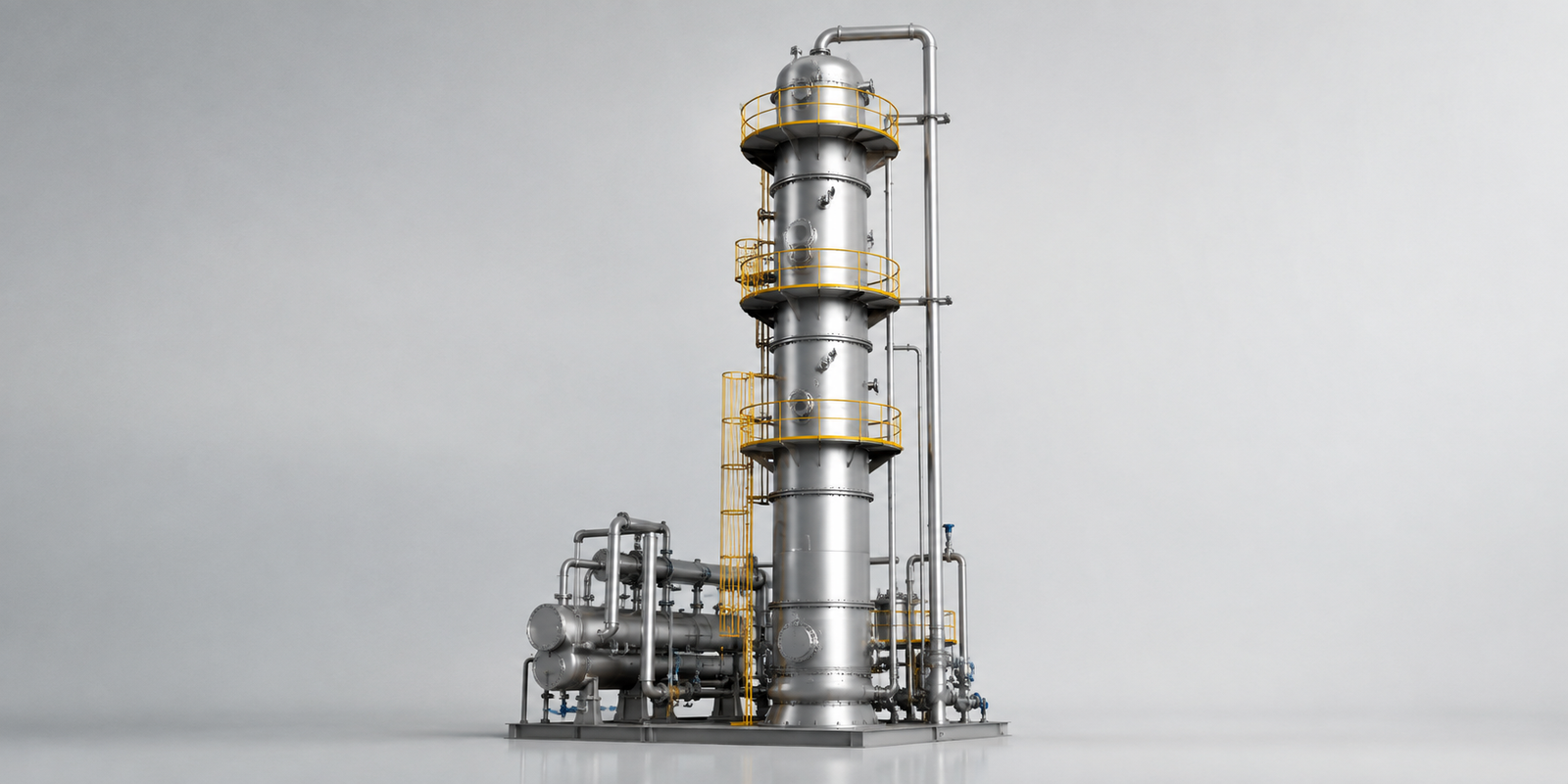
Fractional Distillation Column: the phrase probably brings to mind a tall, insulated cylinder rising several stories into the air, the kind you'd spot walking into almost any refinery or chemical plant. If you've ever wondered what's actually happening inside one, you're not alone. It's one of those pieces of equipment everyone recognizes but few people outside process engineering actually understand.
At Anomizer.com we spend a lot of time with people who need more than the textbook version. Students, plant operators, engineers troubleshooting a flooding tray at midnight — they all end up asking some version of the same question: how does this thing actually work, and why is it built the way it is? This guide is our attempt to answer that properly, covering the different types of columns you'll run into, how a diagram breaks down, what goes into designing one, and the tray and packing choices that decide whether a column performs well or barely limps along.
What Is a Distillation Column?
At its core, a distillation column separates a liquid mixture into its individual parts by taking advantage of the fact that different substances boil at different temperatures. Heat the mixture, and the components with lower boiling points vaporize first, rising toward the top of the column. Heavier, higher-boiling material stays lower down. Vapor and liquid pass each other repeatedly on the way up and down, condensing and re-vaporizing over and over, and each of those exchanges pulls the mixture a little closer to pure separation.
Sounds straightforward. It isn't, really. Diameter, tray or packing geometry, where the feed enters, how much reflux you send back down, pressure drop across the column — all of it interacts. Get one variable wrong and you can end up with a column that technically runs but never hits the purity spec it was built for. That's why, over a hundred years into industrial distillation, engineers still treat column design as something closer to a craft than a formula.
Distillation Column Diagram: Reading the Basic Layout
Pull up almost any distillation column diagram and a few features show up every time, no matter what the column is actually separating. At the top sits a condenser, cooling vapor back to liquid. Some of that liquid returns into the column as reflux; the rest gets pulled off as the overhead product. At the bottom there's a reboiler doing the opposite job — adding heat to vaporize part of the liquid, sending it back up while the remainder leaves as the bottoms product.
Everything in between is the working part of the column: trays or packing where vapor and liquid actually meet and exchange mass. The feed itself enters somewhere in the middle, at a point chosen based on its composition and temperature, splitting the column into a rectifying section above the feed and a stripping section below it. Once this layout clicks, a lot of the "why" behind column design starts making sense — sizing decisions, control strategy, even troubleshooting all trace back to this basic structure.
Types of Distillation Columns
Different feeds and different goals call for different equipment, so no single column design covers every situation. A handful of variations show up repeatedly across industry.
Batch columns handle a fixed volume of feed at once — load it, heat it, separate it in stages, and watch the overhead composition shift as lighter components come off first. You'll find these in pharma and specialty chemical production, anywhere feed composition changes from one run to the next.
Continuous columns, by contrast, run with feed constantly entering and products constantly leaving. This is the default setup for large refineries and bulk chemical plants, where steady-state operation keeps throughput high and avoids the downtime that comes with restarting a batch process.
Then there's vacuum distillation, which drops the operating pressure below atmospheric to lower boiling points. This matters a lot when the material being processed would break down or char at the temperatures atmospheric distillation would otherwise require — heavy oil fractions being the classic example.
And when a mixture forms an azeotrope — a blend that boils at a fixed composition no matter how much you try to separate it — regular distillation hits a wall. Azeotropic and extractive columns get around this by adding a third component, an entrainer or solvent, that breaks the azeotrope and lets separation continue.
Fractional Distillation Column: A Closer Look
If there's one type of column that comes to mind when people picture large-scale distillation, it's the fractional distillation column. This is the workhorse behind petroleum refining, and it works differently from simple distillation, which separates in a single vaporization step. Fractional distillation stacks multiple equilibrium stages inside one tall vessel instead.
Each of those stages — a tray, or a section of packing — gives vapor and liquid another chance to reach equilibrium. Vapor gets richer in lighter components as it climbs; liquid gets richer in heavier components as it falls. More stages, combined with more reflux, sharpens the separation between components whose boiling points sit close together. It's why a crude unit can be over 50 meters tall with dozens of trays stacked inside it, splitting crude oil into gasoline, kerosene, diesel, and heavier cuts in one continuous pass.
Distillation Column Design: Key Considerations
Designing a column is a lot more involved than picking a height and a diameter and calling it done. Engineers usually start with something like the McCabe-Thiele method, or increasingly, rigorous simulation software, to work out how many theoretical stages a given separation actually requires based on feed composition, target purity, and reflux ratio.
From there it's a matter of sizing the diameter to avoid flooding without dropping below the minimum vapor velocity that keeps liquid from weeping uselessly through the trays. Material choice matters too — corrosive feeds or high-temperature service often push the design toward stainless steel or specialty alloys instead of plain carbon steel. Feed tray placement, heat integration with the rest of the plant, and how the control system will actually manage the column round things out. And there's always a trade-off lurking underneath: a taller column with more stages can cut down on reflux and energy use, but it costs more to build in the first place. Somebody has to decide where that line falls.
Types of Trays in Distillation Column
Column internals do a lot of the heavy lifting when it comes to performance, and for large-diameter columns handling high liquid loads, trays are usually the default choice.
Sieve trays are about as simple as it gets — flat plates with holes punched through them, letting vapor bubble up while liquid moves across the surface. Cheap, common, but they don't have much of an operating range before things go sideways.
Valve trays improve on that by using movable caps that lift as vapor flow increases, which gives them a much wider turndown ratio and steadier performance when loads swing up and down.
Bubble cap trays are the oldest of the three, forcing vapor through capped risers and up through a layer of liquid. They handle low vapor rates better than sieve or valve trays, but they cost more to build and more to maintain, which is part of why they've become less common on new installations.
Packed Distillation Column: An Alternative to Trays
Instead of trays, a packed distillation column uses a bed of packing material to create the surface area vapor and liquid need to interact. That packing comes in two broad flavors: structured packing, arranged in a precise geometric pattern, and random packing, made up of small shaped elements simply poured into the column. Either way, packing tends to produce lower pressure drop than trays do, which is a big part of why packed columns show up so often in vacuum service or anywhere energy efficiency is the priority.
Structured packing generally wins on efficiency and capacity, which is why it's become a popular choice when revamping an older trayed column to squeeze more throughput out of the same shell. Random packing still holds its ground in smaller columns, or in services where fouling and corrosion make structured packing a pain to clean.
Final Thoughts
Distillation columns are quietly everywhere — behind the fuel in your car, the plastics in everyday products, plenty of what gets purified and processed before it ever reaches a consumer. Whether you're sizing a packed column for a vacuum service, weighing tray options for a revamp, or just trying to make sense of a diagram in front of you, the same fundamentals apply: vapor-liquid equilibrium, reflux, stage efficiency, and getting the internals right. At Anomizer.com, we keep coming back to this stuff because the gap between the theory in a textbook and a column that actually runs well in the field is where the real learning happens.