


Touch a car radiator after a long drive and you'll understand a heat exchanger better than any textbook definition could teach you. Same with the coil hiding behind your fridge. These things are everywhere in industry, quietly doing their job, and most people who rely on them daily couldn't tell you how they actually work.
At Anomizer.com we spend our days talking to process engineers and plant operators who don't want the recycled textbook version. They want to know what's actually happening inside the unit and why one design beats another for their specific job. This guide walks through what a heat exchanger is, how it works, and how many types of heat exchanger you're likely to run into on the job.
What Is a Heat Exchanger?
At its core, a heat exchanger moves heat from one fluid to another without letting the two mix. One side is hot, the other cold, and a wall — metal, usually, sometimes a tube or a plate — sits between them and lets the heat pass through.
The physics behind it isn't complicated. Heat moves from hot to cold until things even out; that's just how thermodynamics works. A heat exchanger gives that process a defined path and speeds it up using materials that conduct heat well, all while keeping the fluids from ever touching.
Could be liquid, could be gas, could be both at once. Water and steam. Oil and air. Refrigerant moving past ambient air. You'll find these units in power plants, refineries, HVAC systems, food plants, chemical facilities, ships, and honestly, tucked inside half the appliances in your kitchen.
Why They Matter
Energy costs eat into margins at almost every plant. A heat exchanger that's doing its job properly captures heat that would otherwise just vent into the atmosphere and puts it back to work somewhere else in the process. Walk through a refinery and you'll see dozens of these units running at once — some preheating feedstock, some condensing vapor, some pulling heat off exhaust gas before it escapes.
There's a safety angle too, one people don't think about until something fails. Cooling systems keep machinery from cooking itself. Condensers keep steam cycles stable. Radiators keep engines from overheating on a hot day stuck in traffic. Pull the heat exchangers out of any of these systems and things stop running — or worse, they run until they break.
How Does a Heat Exchanger Work?
Strip away the design differences and the core idea is the same everywhere:
- Hot fluid comes in on one side.
- Cold fluid comes in from another direction — could be parallel, could be opposite, could cross at an angle.
- Heat crosses the dividing wall through conduction, then convection takes over on either face.
- The hot stream leaves cooler. The cold stream leaves warmer. They never touch.
How fast this happens comes down to a few things: how big the temperature gap is, how much surface area is available, what the wall is made of, and which way the fluids are flowing relative to each other. Engineers lean on all four of these when they're trying to squeeze more performance into a smaller footprint — adding fins, widening the surface, flipping the flow direction.
How Many Types of Heat Exchanger Are There?
This question comes up constantly with our clients at Anomizer.com. There's more than one way to sort them — by how they're built, by flow direction, by the transfer method — but if you're asking how many types of heat exchanger show up in day-to-day industrial work, the answer settles around eight.
Shell and Tube Heat Exchanger
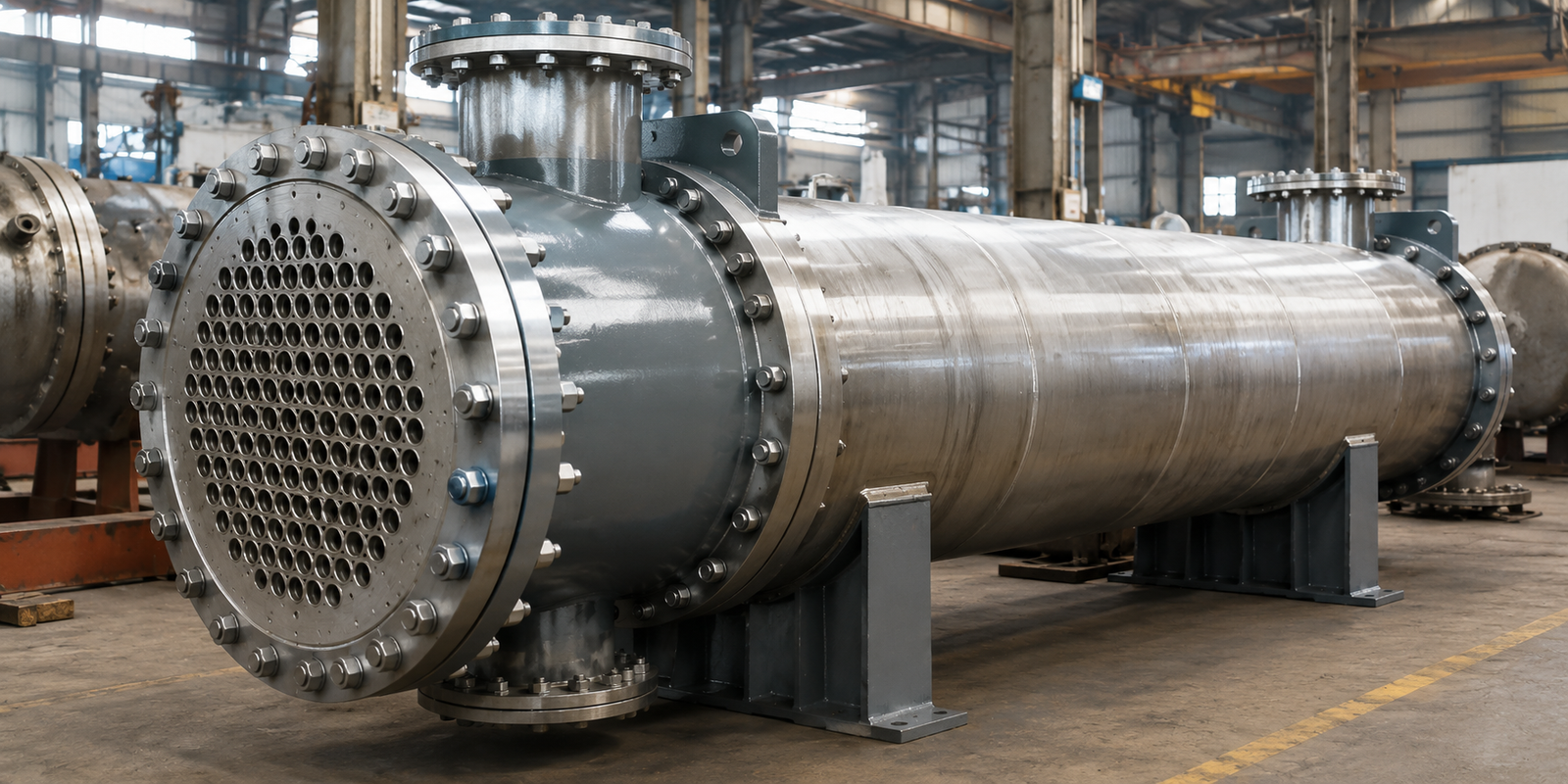
Still the workhorse of the industry. A cluster of tubes sits inside a cylindrical shell, one fluid runs through the tubes, the other moves around the outside of them. It shrugs off high pressure and high temperature, which is exactly why refineries lean on it so heavily.
Plate Heat Exchanger
Thin corrugated plates stacked together, hot and cold fluid alternating between the channels. Small footprint, big surface area, and you can add plates later if demand grows. Dairy plants and HVAC setups use these constantly.
Air-Cooled Heat Exchanger
No water needed — fans push ambient air across finned tubes instead. Makes sense in dry regions or remote sites where hauling in water isn't practical, like a lot of gas processing facilities out in the desert.
Double Pipe Heat Exchanger
The simplest layout there is. A small pipe runs inside a bigger one, fluid flows through the inner pipe while the second fluid moves through the gap around it. Cheap and easy to maintain, but it runs out of steam once you need serious industrial capacity.
Finned Tube Heat Exchanger
Fins bolted onto tubes to widen the surface area, particularly helpful when one of the fluids is a gas that doesn't transfer heat as well on its own. You'll find these in radiators, HVAC coils, refrigeration units.
Spiral Heat Exchanger
Two metal strips wound together into a spiral, creating two channels that run alongside each other. Handles thick fluids and slurry with solids in it better than most other designs, which is why wastewater plants and pulp mills reach for this one.
Regenerative Heat Exchanger
Instead of two fluids flowing at the same time, this design uses a rotating or switching matrix that soaks up heat from the hot side and releases it later to the cold side. Power plants and industrial furnaces use these when waste heat recovery is the main priority.
Adiabatic Wheel Heat Exchanger
A rotating wheel passes heat between two air streams — a common sight in HVAC systems trying to reclaim energy from exhaust air before it leaves the building.
So next time someone asks how many types of heat exchanger exist, eight is the practical answer, though you'll find sub-variants and hybrids within each category depending on the manufacturer.
Flow Arrangement: A Different Way to Sort Them
- Parallel flow — both fluids come in from the same end, moving in the same direction.
- Counterflow — fluids run opposite directions, and this usually wins on efficiency.
- Crossflow — fluids cross each other at an angle, common in air-cooled and finned designs.
Choosing the Right One
There's no single "best" heat exchanger — it comes down to the fluids you're working with, the pressure and temperature range, how much space you've got, how easy it is to maintain, how fast fouling builds up, and what your budget looks like. A plate exchanger is great for a dairy pasteurization line. Put it on a high-pressure steam application and it won't survive — that job belongs to shell and tube.
This is where having people who actually know the equipment matters. At Anomizer.com we match the design to your process conditions instead of pointing you toward whatever's cheapest or most familiar. Get the match wrong and you're looking at wasted energy, constant maintenance calls, and equipment that dies early.
Final Thoughts
It's just metal and tubing on the surface, but a heat exchanger is one of those unglamorous technologies holding up modern industry, transportation, and even basic home comfort. Understanding what a heat exchanger is, how it works, and how many types of heat exchanger exist puts you in a better position to make the right call — whether you're building a new plant or keeping an old one alive.
If your process depends on getting thermal performance right, don't leave it to chance. Talk to the team at Anomizer.com today and get real guidance on picking, sizing, or upgrading the right heat exchanger for your job. Reach out now and start cutting energy costs before your next maintenance cycle rolls around.