



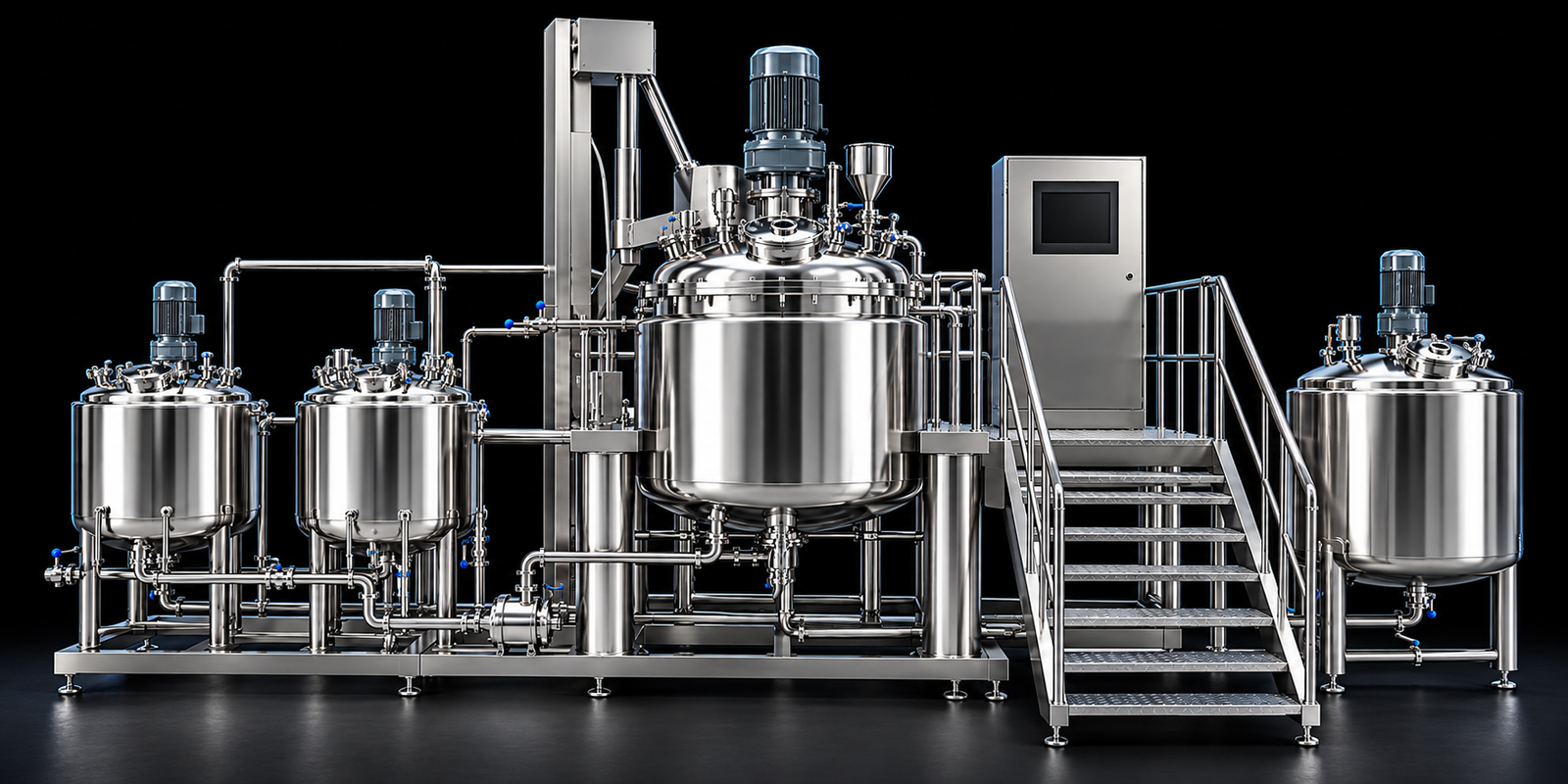
An ointment manufacturing plant is a set of connected machines that melt, mix, emulsify, deaerate, cool and store semi-solid products such as ointments, creams and gels under controlled temperature and vacuum.
Anyone who has stood on a pharmaceutical or cosmetic production floor knows that ointments are harder to make than they look. The base is thick, heat-sensitive and unforgiving. If the mixing is uneven, the active ingredient clumps in one corner of the batch. If the vacuum is poor, trapped air bubbles leave the product grainy. That is why a well-built plant matters more than most buyers expect when they first start planning a unit.
At Anomizer, we design and build ointment manufacturing plants for pharma, cosmetic and personal care producers. This guide explains how these plants work, what to compare before you buy, and how to think about cost.
What an Ointment Manufacturing Plant Includes
The core system usually has six parts:
- Wax or oil phase vessel: melts waxes, petrolatum, fatty alcohols and oils under controlled heating.
- Water phase vessel: dissolves water-soluble ingredients and preservatives.
- Main vacuum mixer (homogenizer): the heart of the plant, where both phases meet and are emulsified under vacuum.
- Ointment storage vessel: holds the finished bulk before filling.
- Transfer pumps and piping: usually lobe or screw pumps, since thick material cannot be moved with an ordinary centrifugal pump.
- Control panel: manages temperature, vacuum, speed and timing.
The main vessel has a jacket for steam, hot water or thermic oil, along with a scraper agitator that keeps cleaning the vessel wall. Without scrapers, the product sticks to the wall, overheats and degrades. A high-shear homogenizer breaks droplets down to a fine, stable size.
Manual, Semi-Automatic and Automatic Plants
Buyers often ask whether they need an automatic ointment manufacturing plant or whether a simpler setup will do. The answer depends on batch volume and regulatory exposure.
|
Feature |
Manual |
Semi-Automatic |
Automatic |
|
Control |
Operator-driven |
Partly operator, partly panel |
PLC and HMI with stored recipes |
|
Best for |
R&D, trials, small batches |
Growing units, several products |
Regulated markets, multiple batches daily |
|
Batch repeatability |
Depends on operator |
Moderate |
High |
|
Data logging |
Paper records |
Limited |
Electronic batch records |
|
Upgrade path |
Difficult |
Possible if PLC-ready |
Already complete |
An automatic plant stores heating curves, vacuum levels, homogenizer speed and hold times, then repeats them batch after batch. This cuts operator-to-operator variation, which is where many quality complaints begin. If you are unsure, a semi-automatic plant with a PLC-ready design lets you upgrade later without replacing the vessels.
Design Details That Separate Good Plants From Average Ones
Two plants can look identical in a brochure and perform very differently. These are the points worth checking.
Material of construction. Product-contact parts should be SS 316L. SS 304 is generally acceptable for jackets and structural frames. Internal surfaces need a mirror or near-mirror finish so residue does not cling.
Vacuum quality. Deaeration gives an ointment its smooth, glossy look and reduces oxidation. A properly sized vacuum pump and a leak-free lid seal are essential.
Scraper agitator design. PTFE or similar scrapers must press evenly against the wall. Poor scraper fit is a common cause of batch inconsistency.
Cleaning provisions. Sanitary tri-clover fittings, smooth welds and optional CIP (clean-in-place) connections reduce downtime between products and lower cross-contamination risk.
Documentation. A reliable builder supplies material test certificates, weld records and calibration certificates, plus design qualification support. For pharma projects that need to align with cGMP expectations, a supplier who cannot produce these is a warning sign.
Ointment Manufacturing Plant Price and Cost: What Drives the Number
Most buyers search for "ointment manufacturing plant price" or "ointment manufacturing plant cost" first. There is no single figure, because the final quote depends on several variables:
- Batch capacity. Plants range from a few litres for R&D to several thousand litres for large-scale production. Cost rises with capacity, though not in a straight line.
- Degree of automation. A PLC-controlled system costs more than a manual one, but often pays back through consistency and lower labour.
- Material grade and finish. SS 316L with a polished interior costs more than 304.
- Homogenizer type and power. Bottom-entry and high-shear designs add to the price.
- Heating method. Electrical, steam and thermic oil systems have different installation needs.
- Add-ons. CIP, load cells, jacketed transfer lines and filling machines change the total.
- Compliance paperwork. Validation documents and FAT/SAT support carry a cost, but they save headaches later.
Instead of chasing the lowest quotation, compare what each one includes. A cheaper plant without vacuum deaeration or proper certificates frequently costs more in rejected batches.
Choosing an Ointment Manufacturing Plant Manufacturer, Supplier or Exporter
Whether you are in search of a plant manufacture for ointments, whether supplier or exporter, the same queries come into mind:
- Does the company manufacture their equipment in-house or use any subcontractor?
- Are there any operating units available from them in your equipment segment?
- Do they conduct any factory acceptance test using your formula or some alternative?
- Do they provide for installation, commissioning, and training?
- How fast can they deliver replacement parts such as seals, scrapers, and gaskets?
- For foreign buyers, do they handle the export documentation and packing process?
As Anomizer manufactures their equipment in India and supplies it to local as well as international buyers, export documentation is our routine task.
Why India is Suitable for Manufacturing Plants for Ointments
India has an extensive range of equipment manufacturers and stainless steel manufacturers in addition to expert welders. This means that anyone seeking a plant manufacturing ointments in India will experience shorter wait times, better customization and availability of local engineers for maintenance purposes. International buyers can expect competitive prices without sacrificing build quality if good inspection practices are adhered to.
A Practical Tip Before You Order
Share your formulation details with the manufacturer before finalising anything. Viscosity, the melting range of waxes, active ingredient sensitivity and batch size all affect how the vessel, scraper and homogenizer should be configured.
A plant designed around your product will outperform a standard catalogue model.
Planning an ointment unit
Share your batch size, product type and target market with the Anomizer team, and we will suggest a configuration that fits your process instead of a one-size-fits-all model.