


Quick answer: Diesel storage tank manufacturers comes down to five decisions — right capacity for your load, horizontal vs. vertical construction, a design that satisfies PESO/Petroleum Rules and your local fire NOC, a realistic cost picture beyond the shell price, and a documentation trail (MTCs, NDT reports, hydrotest records) you can actually audit. Manufacturers who ask about your site before quoting a number are worth shortlisting.
Not every manufacturer builds the same way, and you usually find that out years later — when corrosion, an undersized bund, or a missing certificate shows up out of nowhere. This guide walks through the decisions in the order you'll face them.
Capacity Selection
Size from your genset's fuel consumption at rated load — not a round catalogue number. Three inputs matter:
- Runtime to cover — backup-only sites need far less storage than sites running gensets as primary power for extended hours
- Refill logistics — distance to your fuel supplier and delivery reliability; unpredictable refills mean deliberate oversizing
- License caps — your Petroleum Rules, 2002 license category caps how much you can store before moving into a higher licensing tier
A good manufacturer asks for your litres-per-hour figure, runtime scenarios, and refill interval before proposing a size.
Horizontal vs. Vertical
Mostly a footprint decision, not one being categorically better.
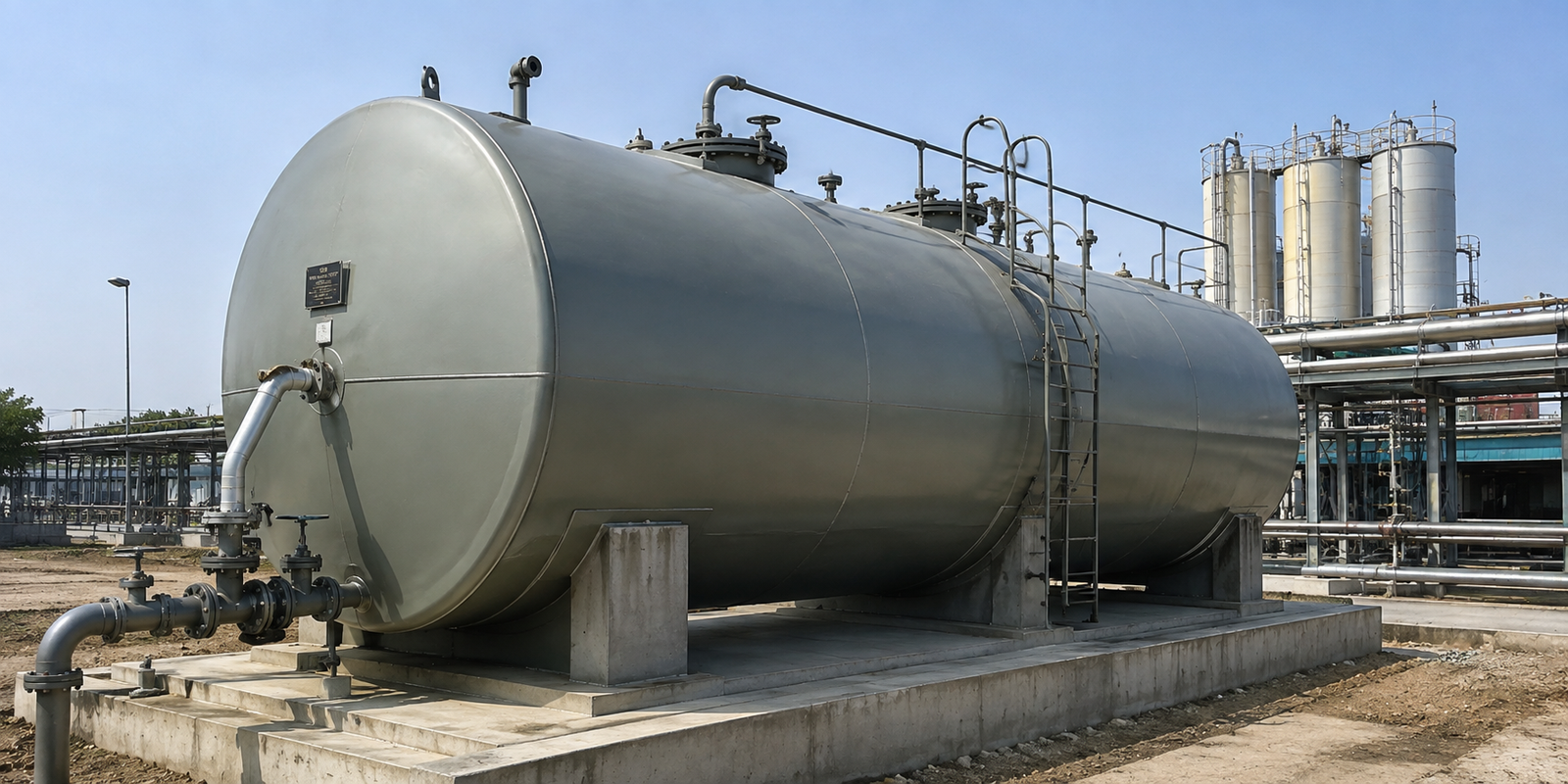
Horizontal suits smaller-to-mid capacities, transports whole on a flatbed, and is easier to access for gauging and maintenance — but needs more ground footprint per litre.
Vertical works once volume outgrows what a horizontal tank can hold without an impractical footprint — the right call where floor space is tight but height clearance isn't.
Decide based on: footprint at the installation point, transport access to site, and whatever orientation your fire NOC layout already assumes.
Approximate Cost Factors
No single per-litre figure holds across projects. What moves the price:
- Construction type — single-wall vs. double-wall (double-wall costs more upfront, but can reduce separate bund construction cost)
- Material grade and thickness — set by design pressure and corrosion allowance
- Coating system — coastal/UV-heavy sites need a more resilient external coating than sheltered indoor sites
- Fabrication location — shop-built is more cost-predictable; field-welded (needed once transport limits are exceeded) adds site labour and on-site testing costs
- Accessories and testing — often quoted separately from the shell
Ask for an itemised quote: shell, coating, accessories, testing, and installation as separate lines, not a bundled number.
PESO Approval and Licensing
Diesel is a Class B petroleum product; storage above certain thresholds needs a PESO license under the Petroleum Rules, 2002. Before finalizing the design, confirm:
- Which license category your intended capacity falls into
- Site layout requirements tied to that license — separation distances from boundaries, buildings, and other storage (LPG needs extra separation from diesel)
- What your local fire NOC adds beyond PESO requirements, since state rules vary
- Whether OISD-STD-118 or OISD-STD-244 is the design reference, and why
Licensing should shape the tank design from the start — not get bolted on after fabrication.
Installation Requirements
- Foundation — level, load-rated for the tank's filled weight
- Bunding — sized per the applicable OISD guideline and local fire NOC, often benchmarked around 110% of capacity, but confirm locally since it varies and must account for pipework and rainfall
- Venting — correctly sized pressure-vacuum and emergency vents; poor venting is a leading cause of moisture ingress and internal condensation
- Earthing and fire protection — required per the fire NOC and typically inspected before it's issued
- Underground tanks — need leak detection and, in most current practice, double-wall construction with interstitial sensors, since corrosion is harder to spot underground
Ask whether installation is in-house or subcontracted — it affects accountability if something doesn't match the design.
Tank Accessories and Instrumentation
Specify these upfront rather than negotiate them down later:
- Pressure-vacuum vent sized for fill/draw rate
- Level gauge (mechanical or electronic)
- Emergency vent, sized separately for fire exposure
- Fire-rated coating where the local NOC requires it
- Leak detection/interstitial sensors (standard on double-wall and underground tanks)
- Manholes and access fittings for inspection
Confirm which of these sit in the base quote versus as add-ons — this is where a low initial number and the final invoice usually diverge.
Documents to Demand From the Manufacturer
Before signing a purchase order:
- The specific design code and why it applies to your site and capacity (API 650 is common, not automatic)
- Material test certificates for the plate steel
- NDT reports (radiography/ultrasonic) on critical welds
- Hydrotest records confirming the shell held test pressure
- Coating specification and warranty terms, especially around corrosion and weld failure
- References from sites with a similar regulatory setup
A manufacturer who hands these over as part of the sales process — not "later if you ask" — tells you something about how they run their shop.
Inspection and Maintenance
Service life comes down to maintenance discipline more than base material. A reasonable baseline:
- Routine visual inspection of coating, corrosion spots, and fittings
- Vent and gauge functional checks
- Bund inspection for cracks, standing water, and debris
- Periodic internal inspection (frequency depends on tank age and service conditions) to catch corrosion or sediment early
- Documented records of every inspection, which matter for license renewal or incident review
There's no fixed lifespan — a well-maintained tank in a benign environment can outlast a neglected one in a corrosive setting by a wide margin.
Anomizer's Manufacturing Capability
Anomizer builds diesel and related storage tanks with in-house welding, NDT, and hydrotesting, working to whichever code applies — OISD-referenced design, BIS material spec, or state-specific fire NOC requirements. Every tank ships with material test certificates, weld inspection records, and hydrotest reports, so the compliance file is ready on arrival. Our work spans diesel, water, LPG, and specialized storage for EPC contractors and industrial clients.
Need a diesel storage tank sized and specified for your site? Get a Custom Diesel Storage Tank Quote from Anomizer's engineering team for code-compliant design, fabrication, and installation support.