
A liquid syrup manufacturing plant has to do far more than mix sugar and water. A syrup may look like the simplest dosage form on a pharmacy shelf, but making it consistently at scale is anything but simple. Viscosity shifts with temperature, sugar can crystallise at the wrong moment, and one weak point in hygiene design can put a full batch in the bin. The plant has to manage all of this within GMP rules, and the decisions made at the planning stage stay with you for fifteen years or more.
Anomizer designs, fabricates and installs oral liquid plants for pharmaceutical and nutraceutical manufacturers. This guide covers what matters when you are buying one.
How a Syrup Plant Works
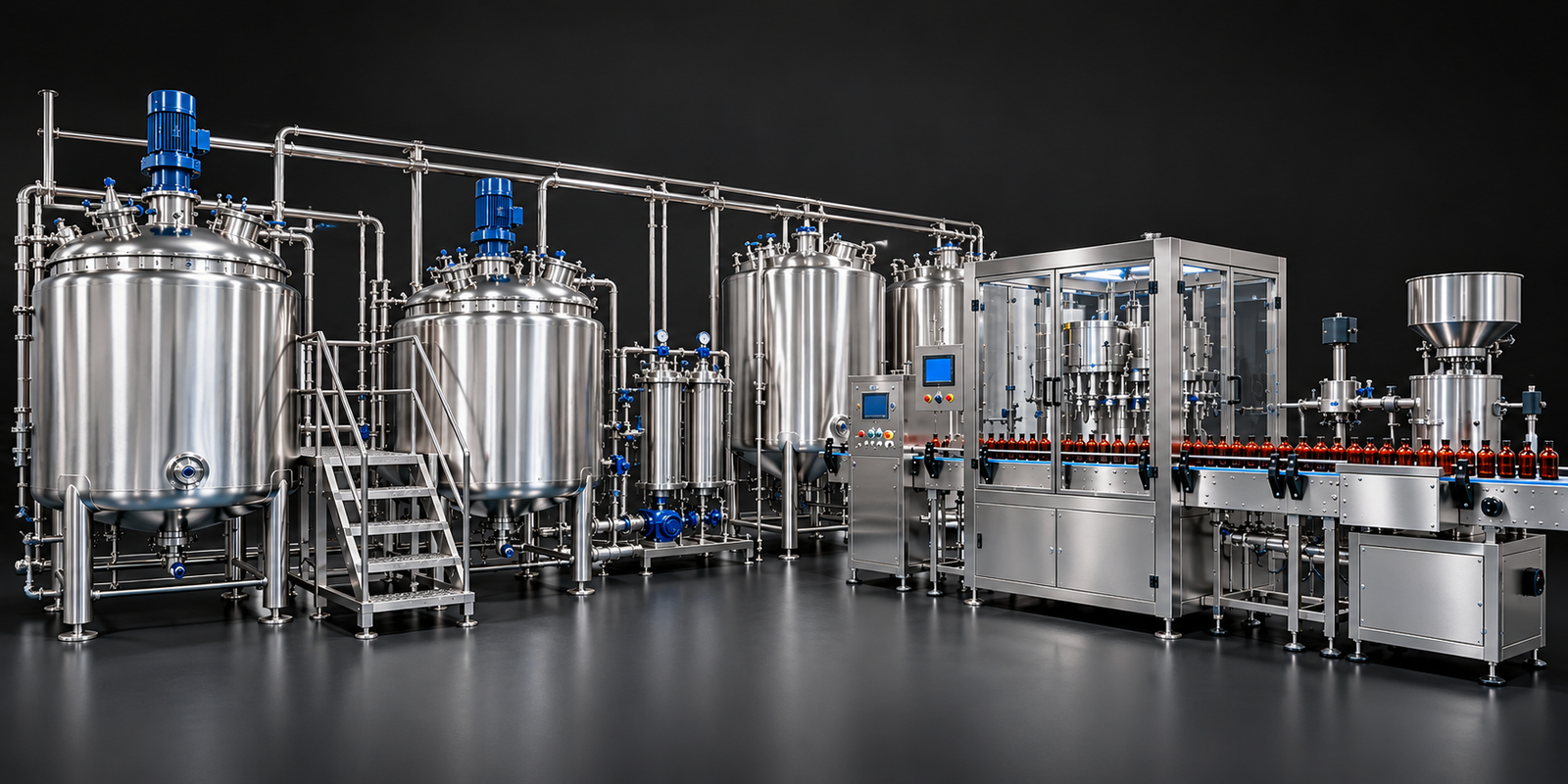
The plant converts sugar, purified water, APIs, preservatives, colours and flavours into a uniform, filled and sealed product. The usual flow:
- Sugar dissolving and base syrup preparation
- Filtration of the base syrup
- Transfer to the manufacturing vessel
- Addition and homogenisation of actives and excipients
- Final filtration and holding
- Filling, capping and labelling
Each stage needs dedicated equipment, and the stages must connect without dead legs, open transfers or manual handling that invites contamination.
Core Equipment, With Typical Working Ranges
The figures below are typical industry ranges for oral liquid plants.
- Capacity: commonly 500 to 5,000 litres
- Heating: steam jacket, with syrup typically dissolved at 70 to 85 °C
- Agitation: slow anchor or paddle stirrer, roughly 20 to 60 rpm, to avoid scorching and foaming
Syrup manufacturing vessel
- Capacity: commonly 500 to 10,000 litres
- Mixing: anchor plus high-shear homogeniser, with homogeniser speeds often in the 1,500 to 3,000 rpm range
- Build: SS 316L contact parts with polished interiors, because rough welds trap residue
Filtration unit
- Plate-and-frame or cartridge housings, often in two stages (coarse, then polishing, commonly down to 5 to 10 micron)
Storage and transfer tanks ([internal link: storage tanks page])
- Sanitary tanks with spray balls, level indicators or load cells, and sanitary pumps
Filling and capping line ([internal link: liquid filling machine page])
- Piston or volumetric fillers, typically 30 to 120 bottles per minute depending on heads and bottle size
- ROPP or screw capping, followed by labelling
CIP system and utilities ([internal link: CIP system page])
- Purified water, steam, compressed air and a CIP skid are easy to under-specify and costly to retrofit
See our full range of [pharmaceutical machinery](internal link: pharmaceutical machinery page).
Automatic vs Semi-Automatic Operation
An automatic plant uses PLC control. Recipes, temperatures, mixing times and transfers run the same way every batch, operators stay out of the product path, and electronic batch records make audits easier.
Semi-automatic plants cost less and suit startups or smaller batches, but quality depends more on operator skill. If growth is likely, design the layout so automation can be added in phases.
Planning for Cough Syrup and Other Oral Liquids
Cough syrup formulations often contain herbal extracts, menthol, sorbitol or glycerin, which change viscosity and foaming. Heat-sensitive actives need controlled dissolving and cooling cycles. Sugar-free bases may need a different agitator and pump. If one line will make several products, prioritise easy cleaning and quick changeover.
Oral Liquid Line: Standards You Should Be Working To
Regulators expect documented proof that your plant is designed and operated correctly. The main references:
- WHO GMP: WHO Technical Report Series No. 986, Annex 2 (GMP for pharmaceutical products: main principles)
- Schedule M: Revised Schedule M of the Drugs Rules, 1945, issued by India's Ministry of Health and Family Welfare and enforced through CDSCO and state regulators
- Sanitary design: ASME BPE is widely used as a design reference for hygienic equipment
Validation Terms in Plain Language
- URS (User Requirement Specification): your written list of what the plant must do
- DQ (Design Qualification): documented proof that the design meets the URS
- FAT (Factory Acceptance Test): testing at the manufacturer's workshop before dispatch
- SAT (Site Acceptance Test): testing again after the equipment reaches your site
- IQ (Installation Qualification): proof that equipment was installed as specified
- OQ (Operational Qualification): proof that it operates correctly across its stated ranges
Ask any supplier to show a sample documentation pack. Its thoroughness tells you how they work.
Turnkey Projects
A turnkey project puts design, fabrication, supply, installation, commissioning and documentation under one responsible party. When something does not fit on site, you have one team to call.
A proper scope covers process design and layout, SS 316/316L contact parts, piping and instrumentation, electrical and control panels, qualification documents with material certificates, and operator training.
Installation Timelines by Project Size
Timelines depend on site readiness more than on the equipment itself. Indicative on-site durations, after equipment arrives and utilities are ready:
|
Project size |
Typical on-site installation and commissioning |
|
Small (500 to 1,000 L, semi-automatic) |
2 to 3 weeks |
|
Medium (2,000 to 5,000 L, PLC-controlled) |
4 to 8 weeks |
|
Large (multi-vessel line with full utilities) |
3 to 6 months from order to production, including fabrication and validation |
Common delays are late civil work, misplaced utility points and equipment that cannot physically enter the building. Anomizer runs a site readiness review before dispatch. Commissioning should include water trials and placebo batches before real product.
Syrup Plant Price: What Decides the Number
Cost depends on batch size, automation level, material and surface finish (SS 316L electropolished costs more than SS 304), filling speed, utilities, and compliance scope. The same logic applies to individual machine pricing: a cheaper mixer with weak sealing or undersized motor costs more in downtime.
|
Capacity |
Automation |
Indicative price range |
|
500 L |
Semi-automatic |
INR 25 to 45 lakh |
|
2,000 L |
PLC-controlled |
INR 80 lakh to 1.5 crore |
|
5,000 L |
PLC-controlled |
INR 1.5 to 3 crore |
Figures are indicative and cover the core process and filling equipment. Final price depends on specification, utilities and site requirements, so request a detailed quotation.
Choosing a Manufacturer or Supplier
Whether you are comparing a plant manufacturer, a supplier or a processing-line builder, check:
- Reference installations: working plants you can visit or phone
- In-house fabrication: control over weld quality and finish
- Material traceability: mill certificates for contact parts
- GMP fluency: clear answers on URS, FAT, SAT and validation
- After-sales support: spare availability and response time
- Customisation: your formulation is not generic
A builder who asks about viscosity, batch plan and future products before quoting is usually the better choice.
Anomizer's Installations
Anomizer designs around the product. Our engineers work with your formulation team on vessel sizing, agitation and layout. We fabricate in-house, document for validation, and stay through commissioning.
Get a Quotation
Tell us your batch size, product type and target regulations, and the Anomizer team will scope the plant with you.