


An ointment manufacturing plant supplier is not someone who just sells you a mixer. You are buying a system that has to turn out the same texture and the same assay, batch after batch. A good supplier asks you more questions than you expect before quoting. One who only sends a price list is a warning sign.
At Anomizer, we build and supply ointment manufacturing plants for pharmaceutical, nutraceutical and personal-care units. This guide explains what separates a dependable supplier from a catalogue reseller.
How an Ointment Plant Actually Works
The oil phase is melted in a jacketed vessel. It usually holds white soft paraffin, cetostearyl alcohol, lanolin or similar bases. The water phase is heated separately and carries preservatives, humectants and water-soluble actives. Both meet in the main vacuum homogenizing mixer, where the emulsion forms under reduced pressure. Vacuum matters because trapped air ruins density, causes filling errors and shortens shelf life.
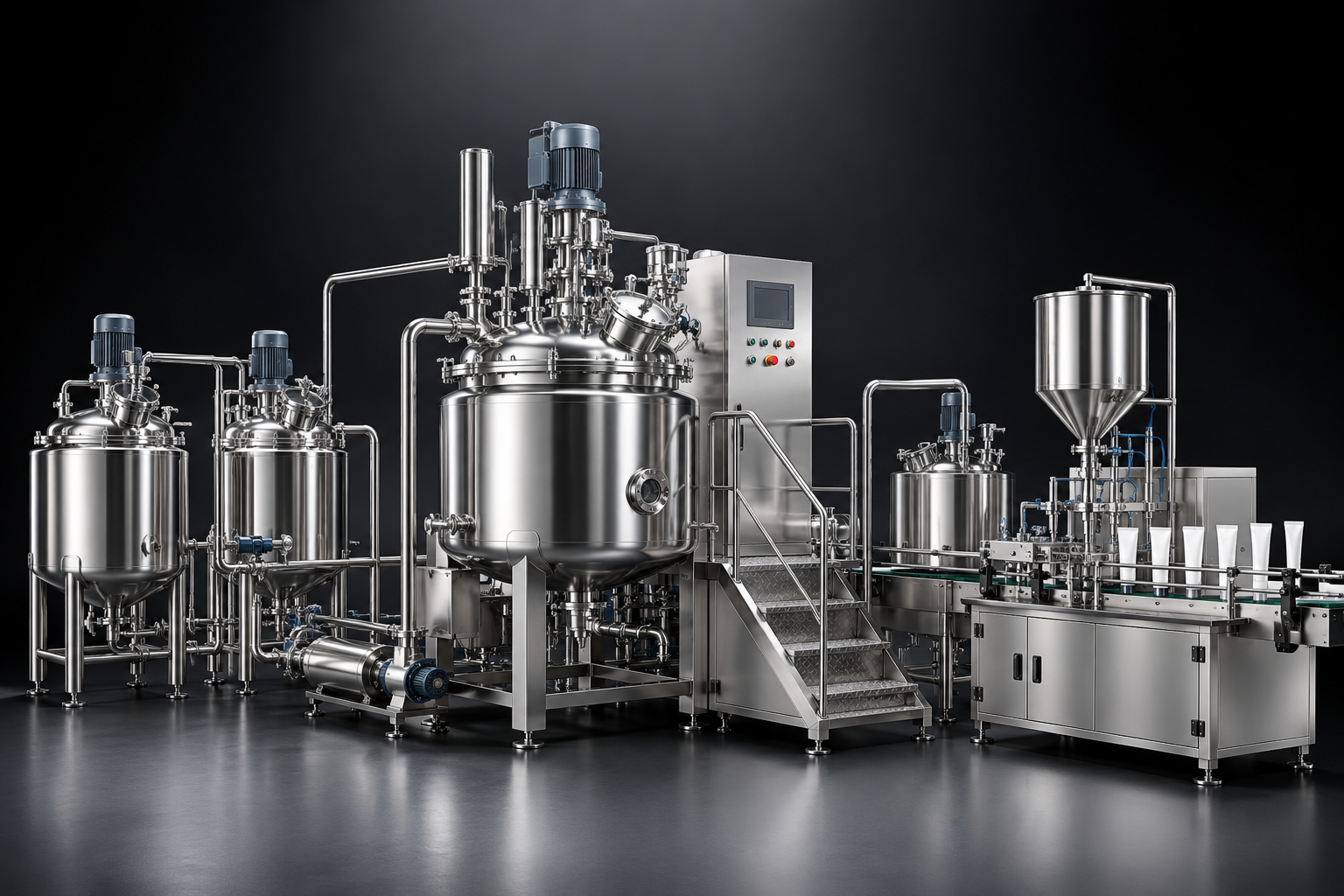
The batch is then cooled while being scraped from the walls and moved to a storage tank or straight to the tube filling machine. A complete plant usually includes:
- Oil phase and water phase melting vessels
- Vacuum emulsifying mixer with homogenizer and scraper agitator
- Vacuum transfer and storage tank
- Colloid mill, where a finer grade is needed
- Tube filling and sealing machine
- Control panel, steam or hot water unit, and chilled water connection
Automatic vs Semi Automatic: Choosing Honestly
An automatic ointment manufacturing plant uses PLC control with recipe storage. Temperature, vacuum, homogenizer speed and mixing time are logged for every batch. It suits regulated markets, frequent audits and large batches where operator variation gets expensive.
A semi automatic ointment manufacturing plant keeps the same core equipment but leaves steps like material charging to the operator. It suits start-ups and contract units running batches of 50 to 500 kg, and the cost is noticeably lower.
If you export or run many products, lean automatic. If you are launching your first license, a well-built semi automatic line is a sensible start and can often be upgraded later.
Why GMP-Compliant Construction Matters
A pharmaceutical ointment manufacturing plant is inspected differently from a general chemical plant. Contact surfaces are normally SS 316L, with SS 304 for non-contact parts. Internal welds should be ground smooth, because crevices hold residue and microbes. Gaskets should be pharma-grade silicone or PTFE.
Ask any supplier for:
- Material test certificates for contact parts
- Surface roughness values for the internal finish
- DQ, IQ and OQ documents
- Drawings aligned with Schedule M and WHO-GMP expectations
If they cannot produce these quickly, you will be doing the paperwork yourself during your own audit.
Cream and Ointment Manufacturing Plant: One Line or Two?
A cream and ointment manufacturing plant can share one line, which is economical, but the products behave differently. Creams are oil-in-water emulsions needing good homogenization. Ointments are stiffer and put more load on the scraper and transfer pumps.
If one vessel handles both, size the agitator, motor and vacuum pump for the harder product. Sizing for creams alone is the classic mistake, and it shows up as stalled mixing in winter. If your range leans toward lotions and skin-care creams, our cosmetic manufacturing plant page covers that side.
Ointment Manufacturing Plant Equipment: What to Press On
When comparing quotes for ointment manufacturing plant equipment, look beyond capacity in liters:
- Homogenizer type. Bottom entry usually gives finer droplet size than top entry.
- Scraper design. PTFE scrapers wipe the wall continuously and improve heat transfer.
- Jacket design. A well-designed jacket shortens the batch cycle.
- Vacuum stability. A weak pump leaves foamy, aerated product.
- Cleaning provisions. CIP spray balls cut changeover time.
Two plants of the same nominal size can differ by 30 percent in batch time because of these details.
Exporting and Sourcing from India
An ointment manufacturing plant in India costs less than a comparable European or American build, and engineering depth has improved a lot in the last decade. Buyers in Africa, the Middle East, Southeast Asia and Latin America source from Indian fabricators for this reason.
A genuine ointment manufacturing plant exporter handles more than the machine. Look for export crating, factory acceptance testing before dispatch, correct HS code paperwork, certificates of origin and a commissioning plan. Ask whether engineers will travel for installation, and whether spare parts reach your region quickly.
How to Judge a Supplier
Pharma equipment fails quietly. A worn seal will not stop production on day one, but it changes batch quality over weeks. So judge the track record, not the brochure. Ask for:
- Operating installations you can contact
- Photographs of the real fabrication shop
- A trial batch on your formula, if possible
- A written warranty with breakdown response time
- Details of operator training
Anomizer designs each plant around the customer's formulation, batch size and utilities. Our engineers review the rheology of your product first, because a petroleum jelly base and a hydrophilic cream need very different agitation.
Talk to an Engineer First
Planning a new line or upgrading an old one? Contact our team with your product list and expected batch size, and Anomizer will suggest a plant configuration that fits your formula and budget.