


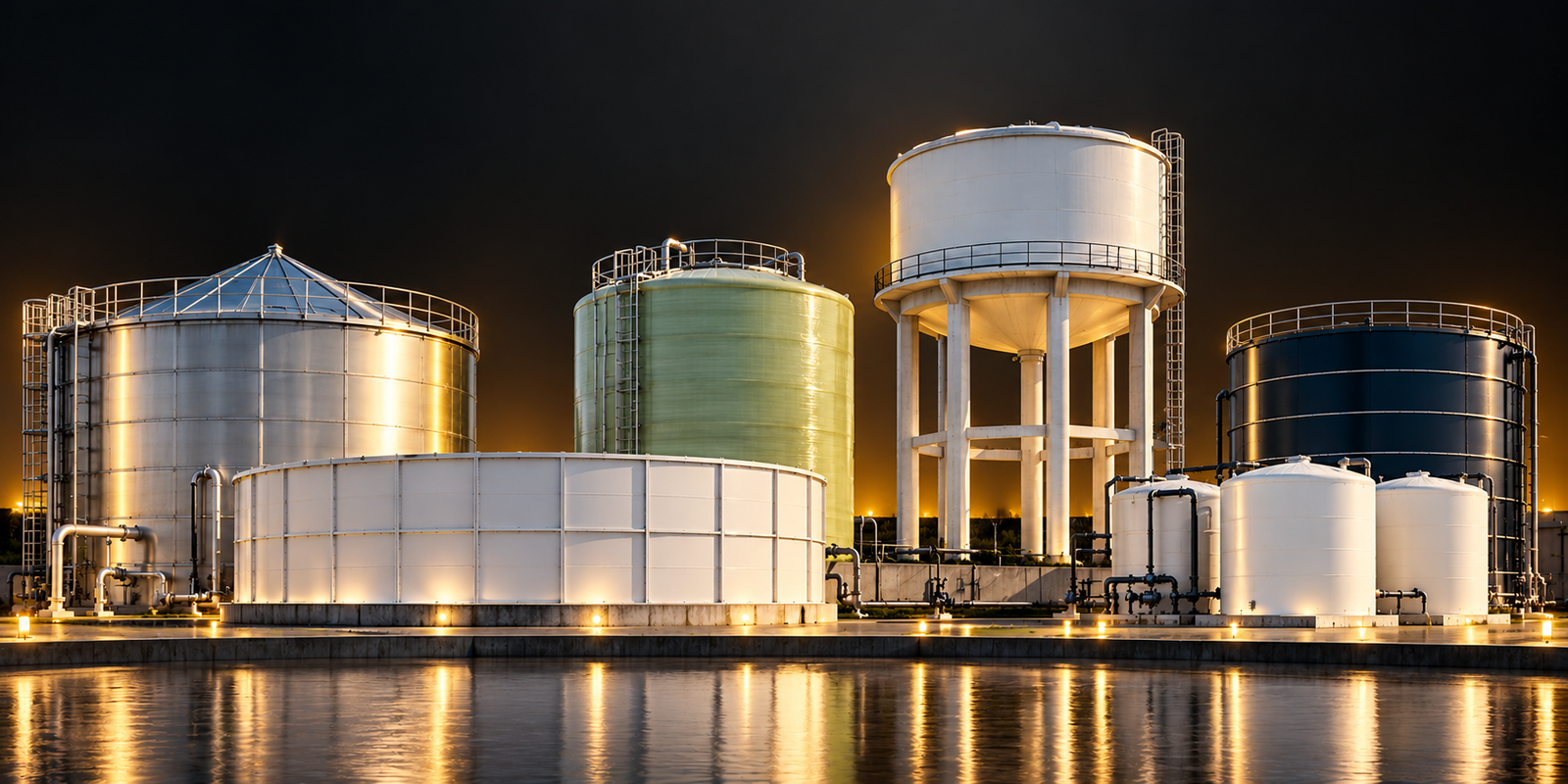
Quick answer: water storage tanks depends on four things: the type of water, the volume you need, the site conditions and how easily the tank can be cleaned. Stainless steel suits drinking water, FRP suits corrosive or coastal sites, and lined mild steel suits large industrial volumes.
Water storage tanks look simple, but anyone who has dealt with a leaking seam, a green-tinged supply or a tank that corroded in three years knows the choice is not trivial. The material, shape, roof design and location all decide how long a tank lasts and whether the water inside stays usable. At Anomizer, this is how we talk through a requirement with a plant manager or a municipal engineer.
What a Water Storage Tank Has to Do
A tank must hold volume safely, keep the water clean and let you draw it out at the right rate and pressure.
Most failures come from ignoring one of these. A strong tank with poor venting can collapse under vacuum when emptied fast. A tank with a poor inlet and outlet layout leaves stagnant water at the bottom. Before choosing a material, note the water type (potable, process, fire reserve or treated effluent), the daily draw and whether the tank will sit outdoors.
Above Ground Water Storage Tanks
Above ground water storage tanks are the most common choice for plants, farms, housing societies and construction sites because they are cheaper to install and easier to inspect and repair.
You can walk around the shell, check weld lines and spot a weep long before it becomes a problem. The trade-off is exposure. Sunlight heats the water and encourages algae, and weather works on the shell and roof. An opaque material, a proper roof and a well-prepared foundation solve most of this. Larger tanks usually need a ring wall or concrete slab, because an unevenly settled base stresses the bottom plate and shell joint.
Choosing the Material
Use stainless steel for hygiene, FRP for corrosion resistance and lined mild steel for large, cost-sensitive volumes.
Stainless steel resists bacterial growth, does not leach and cleans well. Drinking water duty usually points to 304 or 316, with 316 preferred where chlorides are present.
Mild steel needs an epoxy or similar lining so the water never touches bare metal. The lining is the real asset, so inspect it on a schedule.
FRP (fibre reinforced plastic) does not rust, is light enough to move without heavy lifting equipment and handles mildly aggressive liquids well. An FRP storage tank is a good fit for coastal sites and water treatment plants. Wall thickness and resin should be specified against the actual liquid and temperature, not a catalogue default.
HDPE and polyethylene work for smaller capacities but have limits on size, temperature and long-term UV exposure.
Shape and Roof: Why Design Matters
Cylindrical tanks spread pressure evenly and suit large volumes, while cuboid tanks save floor space but need extra reinforcement.
A question we hear often: a storage tank is in the form of cube in some designs, so is it practical? Yes. Sectional panel tanks are assembled in cubic or cuboid form and are popular on rooftops and in basements, because panels fit through a normal door and are bolted together on site. The catch is that flat walls bulge under load, so they depend on tie rods or external frames, and the gaskets between panels need periodic checking.
A cone roof storage tank is common for larger vertical tanks. The sloped roof sheds rainwater, supports venting and avoids the ponding a flat roof invites. For potable water, the roof should be sealed, with an insect-proof vent and a lockable manway.
Drinking Water Storage Tank Requirements
A drinking water storage tank needs non-toxic material, smooth interior surfaces, light-tight construction and an inlet and outlet layout that keeps the water turning over.
Plan cleaning access from the start. A tank you cannot enter, drain fully and scrub will eventually be contaminated. A sloped floor, a bottom drain and a properly sized manway are cheap at the design stage and expensive to retrofit.
City Water Storage Tanks
City water storage tanks buffer demand, hold fire reserve and keep network pressure stable.
Municipal supply never matches consumption perfectly, so storage evens out morning and evening peaks. Elevated tanks provide pressure by gravity, while ground-level reservoirs usually feed pumping stations. Design points include seismic and wind loading, long service life and compartments, so one section can be cleaned while the other stays in service.
Not All Tanks Are for Water
Chemical and gas tanks follow different design rules and should never be treated as variants of a water tank.
Chemical storage tanks manufacturers build for compatibility, containment and venting, since contents may be corrosive or reactive. A gas storage tank is a pressure vessel, designed to a different code with different safety devices. If a facility stores both water and process chemicals, keep specifications, inspection routines and materials separate.
What to Check Before Ordering
Confirm capacity, material, foundation, nozzle layout, fabrication quality and maintenance access before you commit.
- Capacity with margin. Size for peak demand plus a reserve, not average use.
- Material against the liquid. Confirm chloride level, pH and temperature before choosing grade or resin.
- Foundation. Ask who is responsible for it and what load figures the design assumes.
- Nozzle layout. Inlet, outlet, overflow, drain, level instrument and vent should be on the drawing.
- Fabrication quality. Ask about weld inspection, testing and documentation.
- Maintenance access. Ladders, platforms, manways and cleanout points.
Talking to a Fabricator
The best tank is engineered around your actual duty: water quality, volume, site and maintenance habits. At Anomizer, the conversation starts with those details, before anyone mentions a price or a drawing. Share your requirement, and a proper specification will follow.