



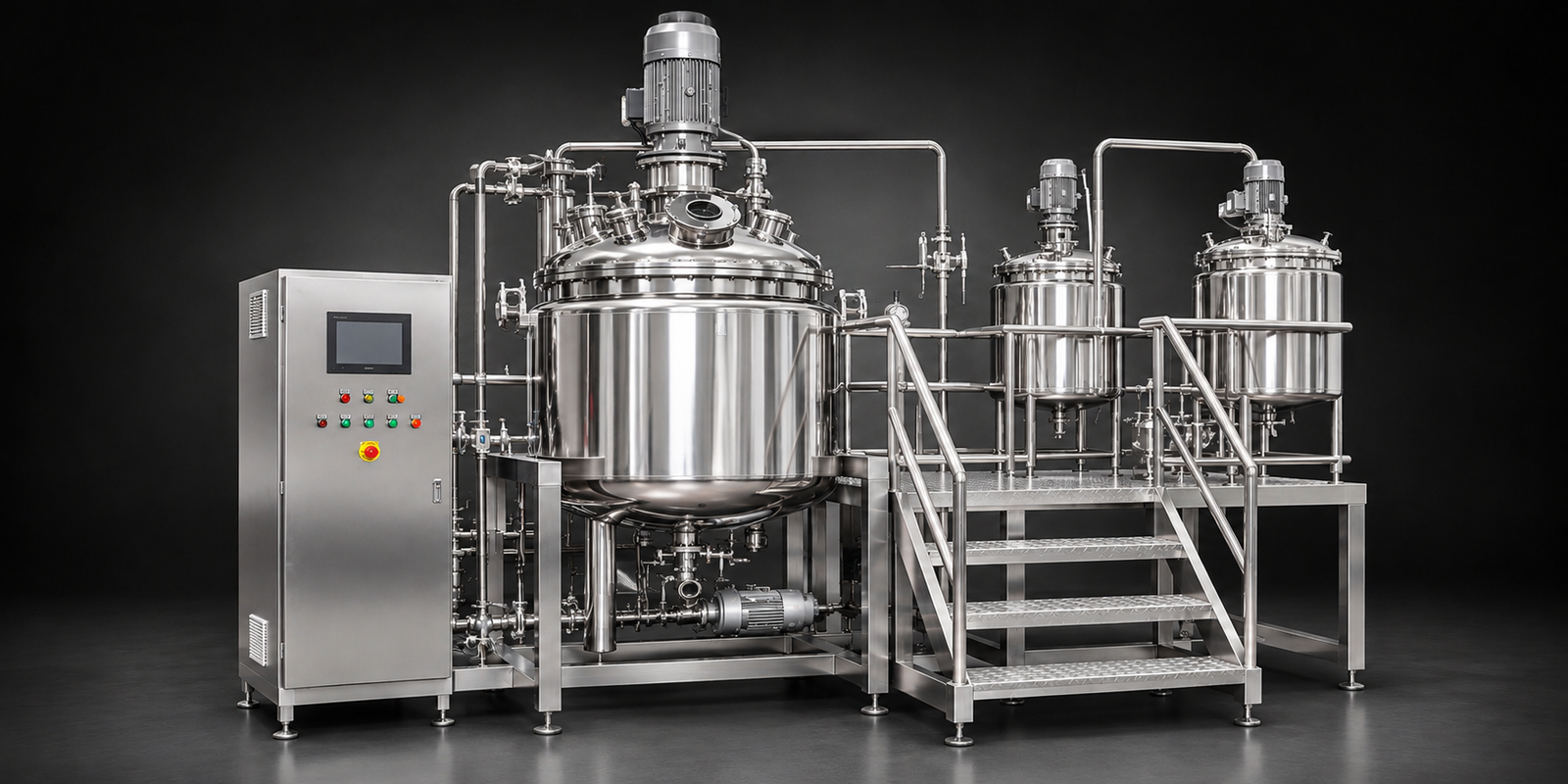
Pharmaceutical ointment manufacturing plant is the name for a closed, vacuum-based processing system that melts, mixes, emulsifies, deaerates and cools semi-solid formulations so every batch comes out smooth, uniform and free of contamination. If you make topical antibiotics, steroid creams, antifungal ointments or dermatological gels, this single system decides whether your product passes content uniformity, viscosity and microbial limits. At Anomizer, we build ointment manufacturing plants for formulators who cannot afford batch-to-batch variation, and this guide covers what actually matters when you specify, install and maintain one.
What a Pharmaceutical Ointment Manufacturing Plant Does
Ointments and creams are tricky because they combine materials that don't want to mix: waxes, petrolatum, liquid paraffin, water, actives and preservatives. A cream and ointment manufacturing plant forces these phases into a stable emulsion or suspension under controlled temperature and vacuum, inside a sealed vessel, so the product never touches open air.
The output is a homogeneous base that can go straight to tube filling or jar filling. A good plant gives you a consistent particle or globule size, no trapped air bubbles and a repeatable cooling profile.
Core Components of the Plant
Every ointment manufacturing plant is built around a few main blocks. Knowing them helps you read a quotation properly.
- Main manufacturing vessel: A jacketed, vacuum-rated tank where the final emulsification happens. Contact parts are usually SS 316L, with SS 304 for the outer shell.
- Water phase vessel: A smaller jacketed tank for dissolving water-soluble ingredients, humectants and preservatives.
- Oil phase vessel: A heated vessel for melting waxes, fatty alcohols and petrolatum.
- Anchor agitator with PTFE scrapers: Sweeps the vessel wall so cooled product doesn't cake and heat transfers evenly.
- Homogenizer: A high-shear rotor-stator, mounted at the bottom or top of the vessel, that breaks droplets down to a fine, stable size.
- Vacuum pump: Removes air during mixing and transfers phases into the main vessel without exposure.
- Control panel: PLC or HMI-based, handling temperature, speed, vacuum and batch recording.
- Transfer lines and pumps: Sanitary pipework with tri-clamp fittings for moving the finished product to the filling stage.
Ointment Manufacturing Plant Working Principle
The working principle is simple to describe and demanding to execute. Heat reduces the viscosity of the fatty phase, vacuum protects the mix from oxygen and air, and shear creates the emulsion.
The oil phase and water phase are heated separately, typically in the range of 70 to 80°C, depending on the wax melting points in your formula. Both are then drawn into the main vessel under vacuum. The anchor agitator keeps the bulk moving slowly while the homogenizer runs at high speed to create the emulsion. Once emulsified, the batch is cooled through the jacket while the scraper agitator keeps the product moving, until it reaches filling temperature, often around 35 to 40°C.
Ointment Manufacturing Plant Process, Step by Step
Every plant is a little different, but the day-to-day flow on the shop floor usually goes like this.
- Get the phases ready. The operator weighs everything out first, then melts the waxes and fatty ingredients in the oil vessel while the water-soluble ingredients heat up in their own tank. Both sides need to reach nearly the same temperature, otherwise the oil can start to set the moment it meets the water.
- Pull the phases in under vacuum. Instead of pouring from buckets, the main vessel draws each phase through a sanitary line. The water phase goes into the oil phase slowly, which stops the mix from splitting and keeps outside air and dust out of the batch.
- Run the homogenizer. This is where the emulsion actually forms. The high-shear head breaks the droplets down until they are small and even. The run time comes from your validation work, so it should be written into the recipe and never left to guesswork.
- Add the sensitive ingredients last. Preservatives, fragrances and heat-sensitive actives go in once the batch has cooled to a safe temperature. If you add them while the batch is still hot, you risk losing potency before the product is even filled.
- Remove the trapped air. With the agitator turning gently, the batch is held under vacuum for a short while. Air bubbles cause uneven filling and shorten shelf life, so this step is worth the few minutes it takes.
- Cool and discharge. Cooling water or chilled glycol runs through the jacket while the scrapers keep the product moving along the wall. Once it reaches filling temperature, the batch leaves through the bottom valve and heads to storage or the tube filler.
Order matters more than most people expect. Add an active too early, or let the homogenizer run too long, and a perfectly good formula can turn thin or lose strength. That is why a panel with proper recipe control pays for itself, because every operator on every shift repeats the same steps the same way.
Ointment Manufacturing Plant Capacity
Capacity is measured by working batch volume, not total vessel volume, since you need headspace for foaming and vacuum. Plants commonly range from small R&D and pilot units of 5 to 50 litres, through mid-scale units of 100 to 500 litres, to production plants of 1000 to 5000 litres.
Pick capacity from your real batch plan. If you run several small-volume products, a 300 or 500 litre plant with good cleaning access often beats a 2000 litre vessel that runs half-empty. Half-filled vessels affect homogenizer performance and heat transfer, so avoid running below the minimum working volume the manufacturer states.
Ointment Manufacturing Plant Specifications to Check
When comparing quotations, look beyond price and ask for these specifications in writing:
|
Parameter |
What to look for |
|
Contact material |
SS 316L, electropolished or mirror finish |
|
Surface roughness |
Ra 0.4 µm or better on product-contact surfaces |
|
Jacket design |
Dimple or half-pipe jacket rated for steam or hot water |
|
Vacuum level |
Typically up to -0.9 bar, with a rated pump |
|
Homogenizer speed |
Variable speed, usually 1500 to 3000 RPM depending on batch size |
|
Seals |
Double mechanical seals with a suitable barrier fluid |
|
Automation |
PLC with recipe storage, audit trail and alarms |
|
Documentation |
Material test certificates, FAT report, IQ/OQ support |
Compliance matters too. In India, plants are expected to meet cGMP requirements under Schedule M, and exporters often follow US FDA cGMP regulations and EU GMP expectations. Ask how the design supports cleaning validation, because that is where most inspection observations begin.
Ointment Manufacturing Plant Equipment Beyond the Mixer
A complete line usually extends past the main vessel. Think of the following as part of the full ointment manufacturing plant equipment list: a powder or liquid dosing station, a colloid mill for stubborn suspensions, a storage hopper, a tube filling and sealing machine, a CIP (clean-in-place) skid, and utilities such as a steam generator, a chilled water unit and a purified water loop. Sorting out these items early prevents delays when the plant arrives.
Ointment Manufacturing Plant Installation
Installation goes much smoother with preparation. Before the plant ships, confirm these points on site:
- A level floor with enough load-bearing strength, since a full 1000 litre vessel is heavy
- Utility points ready: electricity, compressed air, steam or hot water, chilled water and drain
- Adequate ceiling height and door width for the vessel and any top-mounted agitator
- A clean room layout that keeps people and materials on separate flows
Once the equipment is in place, the usual sequence is positioning, piping, electrical hookup, leak and pressure testing, then qualification. Installation Qualification (IQ) checks that what arrived matches the design. Operational Qualification (OQ) tests that it runs as intended. Performance Qualification (PQ) proves it makes good product, usually with placebo and then real batches.
Ointment Manufacturing Plant Maintenance
Most breakdowns in these plants trace back to a short list of wear parts, so a simple routine saves a lot of downtime.
- Daily: Check for leaks, inspect gauges and clean the vessel as per SOP.
- Weekly: Inspect PTFE scrapers for wear, check barrier fluid levels and look at the vacuum pump oil.
- Monthly: Examine gaskets and tri-clamp seals, test safety valves and verify temperature sensors.
- Yearly: Replace mechanical seals if needed, recalibrate instruments and re-verify the jacket for fouling.
Keep a spare kit on hand with gaskets, scrapers, a mechanical seal and a spare temperature probe. Log every intervention, since auditors want to see that maintenance is controlled and traceable.
Why Formulators Choose Anomizer
Our focus at Anomizer is on process equipment that suits real production floors, not showroom brochures. We discuss your formulation, batch size and cleaning approach before we propose a layout, so the plant matches the way you work. If you are planning a new line or upgrading an older one, fill in our contact form with your batch volumes and product types, and our team will recommend a configuration you can validate without surprises.