

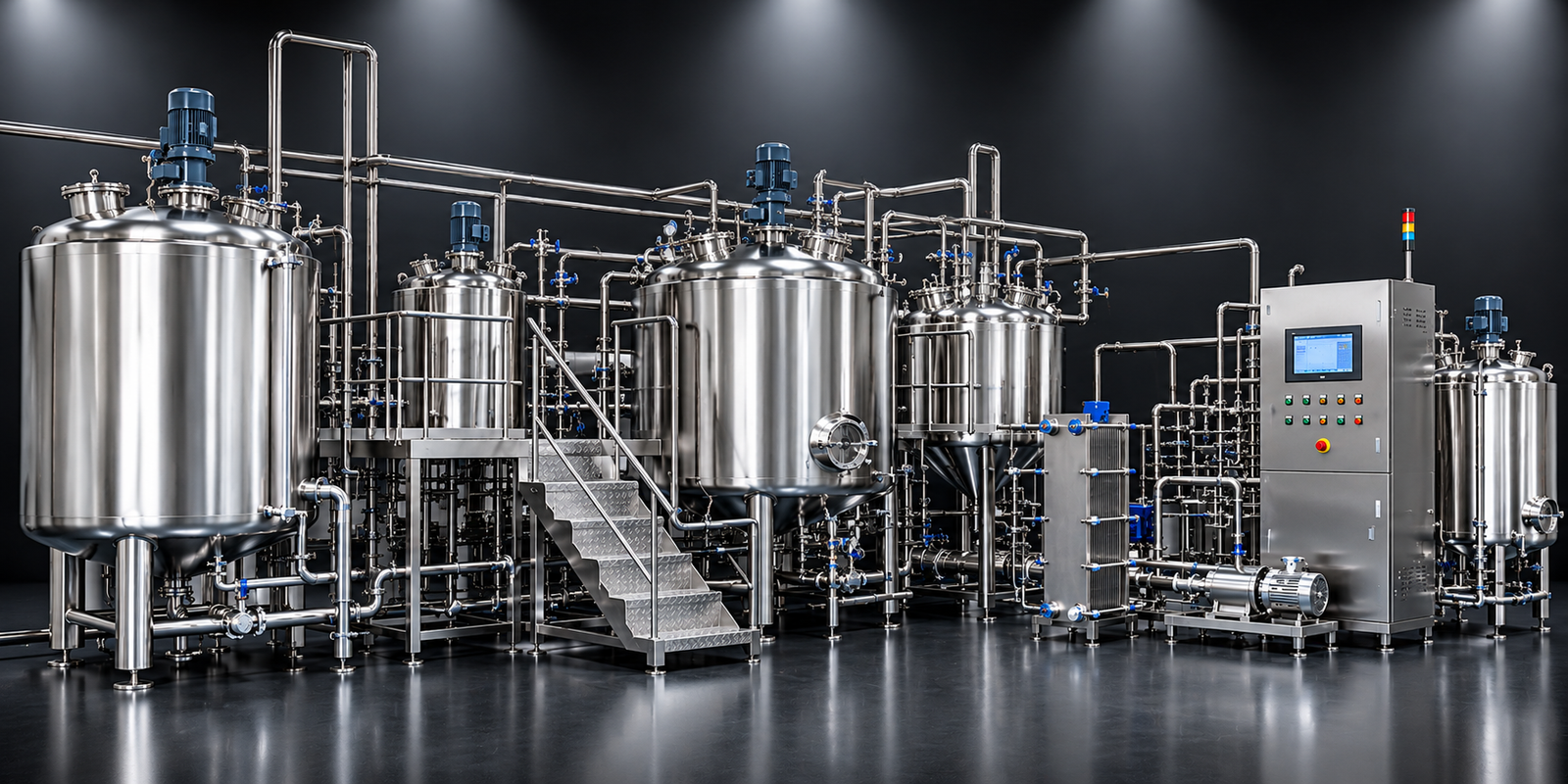
An Automatic Liquid Syrup Manufacturing Plant is built to remove the small, daily inconsistencies that creep into oral liquid production. Walk into a pharma unit that still makes syrup in semi-manual tanks and you will hear the same complaints. Sugar dissolves differently on a cold morning. Someone forgot to log the temperature. The batch passed, but viscosity sits at the edge of the limit again. None of it is dramatic, yet it adds up to rework, deviations and long conversations during audits.
At Anomizer, we design and fabricate these systems for pharmaceutical and nutraceutical manufacturers. This guide shares what we have learned about how a liquid syrup manufacturing plant works, what it costs, and how to choose one without regretting it two years later.
How the Plant Works, Stage by Stage
A pharmaceutical syrup manufacturing plant is really a chain of vessels joined by sanitary piping, with a control system tying everything together. The flow usually goes like this.
Sugar and purified water enter a jacketed dissolving tank. Hot water or steam in the jacket brings the mixture to roughly 60 to 80°C while a slow agitator keeps the sugar from settling. Once it dissolves, the hot syrup passes through a filter to remove haze and stray particles, then moves to the main manufacturing vessel. Here it cools, and the actives, preservatives, flavours and colours go in, in a fixed order. For suspensions, a homogenizer or high-shear mixer joins the process at this point. The finished bulk is pumped to a storage tank and waits there until QC releases it for filling.
In an automatic oral liquid manufacturing plant, the pumps, valves, heating and agitator speeds all follow a recipe stored in the PLC. The operator picks the batch, confirms material additions, and the system handles timing and temperature. Every parameter gets logged without anyone scribbling on a clipboard.
Why Manufacturers Move to Automatic Systems
Consistency. The same recipe, ramp rate and hold time on every batch. Viscosity, pH and assay values settle into a narrower band.
Less exposure. Closed transfers through SS piping mean fewer moments with an open tank. That matters, because syrup is a comfortable home for microbes the moment hygiene slips.
Better records. Auditors want to see what actually happened, not what someone remembered to write down later. Data logs from the PLC answer that directly, and they fit well with WHO-GMP and revised Schedule M expectations.
Less waste. Fewer manual transfers mean less spillage and more predictable yield. Over a year of production, that quiet saving is often bigger than people expect.
What to Check in a Design
Brochures all look alike. These details are what separate plants once they are on your shop floor.
Contact-part material. SS 316L for anything that touches product, with a smooth internal finish. Rough welds hold residue. Ask for surface roughness values instead of accepting a vague "mirror finish."
Piping layout. Dead legs are where product hides. Sloped lines, few branches and tri-clover fittings keep cleaning honest.
Agitator behaviour. Syrup is thin when hot and heavier when cooled. An agitator tuned for only one of those conditions will either foam or leave dead zones in the other.
Degassing. Trapped air throws off fill volume. A vacuum-capable mixing vessel helps a lot with sorbitol-heavy and viscous formulations.
Cleaning readiness. Spray balls and proper drain points mean you can add CIP later without tearing the plant apart.
Documentation. DQ, IQ and OQ support, material test certificates, weld records. A pharmaceutical liquid manufacturing plant that arrives without paperwork is a liability, not a bargain.
Syrup Manufacturing Plant Cost: What Drives the Number
There is no honest fixed price, and anyone quoting one without asking questions should make you cautious. As a rough direction, compact semi-automatic setups start in the tens of lakhs of rupees, while fully automatic multi-vessel lines with homogenizer, vacuum, PLC and data logging can reach into the crore range.
What actually moves the syrup manufacturing plant cost:
- Batch size, because 500 litres and 5,000 litres are different machines
- Level of automation, from manual valves to pneumatic actuation with a full HMI
- Steel grade and surface finish
- Extras such as a CIP skid, vacuum unit, homogenizer or extra filtration
- The validation and documentation package
When you compare a liquid oral syrup manufacturing plant price from two suppliers, line up the scope first. A low quote very often just leaves out the control panel, the documents or the testing.
Choosing a Liquid Syrup Plant Supplier
Ask for client references in pharma, and call them. Insist on GA drawings and P&IDs before fabrication starts, not after the order. Check that the equipment goes through a factory acceptance test with water or placebo. Find out how quickly spares and service engineers can reach you.
Also notice who asks questions. A serious syrup manufacturing plant manufacturer will want your viscosity range, batch size, target market and available utilities before quoting. A liquid syrup plant supplier who sends a price within an hour is selling a catalogue item, not a plant built around your product.
Where an Oral Liquid Processing Plant Fits in Your Facility
Space and utilities are often an afterthought. An oral liquid processing plant needs steam or a hot water source, chilled water for cooling, compressed air for pneumatic valves, purified water at the right point of use, and drainage that works with your cleaning method. Mapping these before the order saves you from costly site changes during installation. Ceiling height matters too, since storage tanks and vacuum-capable vessels can be taller than expected.
How We Approach It at Anomizer
We start with your product. Clear syrups, suspensions and sugar-free formulations behave differently, so vessel sizes, agitation and filtration follow from that conversation. We fabricate in our own facility, test before dispatch, and support installation and commissioning at your site.
The goal is plain: a plant your operators can run without drama and your QA team can defend on audit day.
Closing Note
An automatic syrup plant is a long-term commitment, and the decisions made at specification stage echo for years. Get the material, layout, automation level and documents right, and the plant fades into the background. Get them wrong, and you feel it in every batch.
If you are planning a new line or upgrading an existing one, share your formulation and capacity with the Anomizer team, and we will help you shape a specification that fits.