


A pressure vessel does one job: it holds gas or liquid at a pressure different from the air around it. When one fails, the result is rarely a small leak. It is usually a shutdown, an injury, or an accident investigation. That is why picking a pressure vessel manufacturer is a safety decision first and a purchasing decision second.
This guide explains what a pressure vessel is, the main types, the codes behind them, and how to judge a manufacturer in India. It reflects the questions buyers ask us at Anomizer before they commit to a purchase order.
What Is a Pressure Vessel?
A pressure vessel is a closed container built to hold fluids at pressures well above or below atmospheric pressure. Air receivers, boilers, reactors, heat exchanger shells, LPG bullets, and water treatment filter shells all fall into this group.
The danger comes from stored energy. A compressed gas releases energy suddenly if the shell ruptures, which is why design rules are strict and why a pressure vessel tank is never treated like an ordinary storage tank.
Common Types of Pressure Vessel
Buyers often search for "types of pressure vessel" and get a textbook list. In practice, vessels are grouped in a few useful ways.
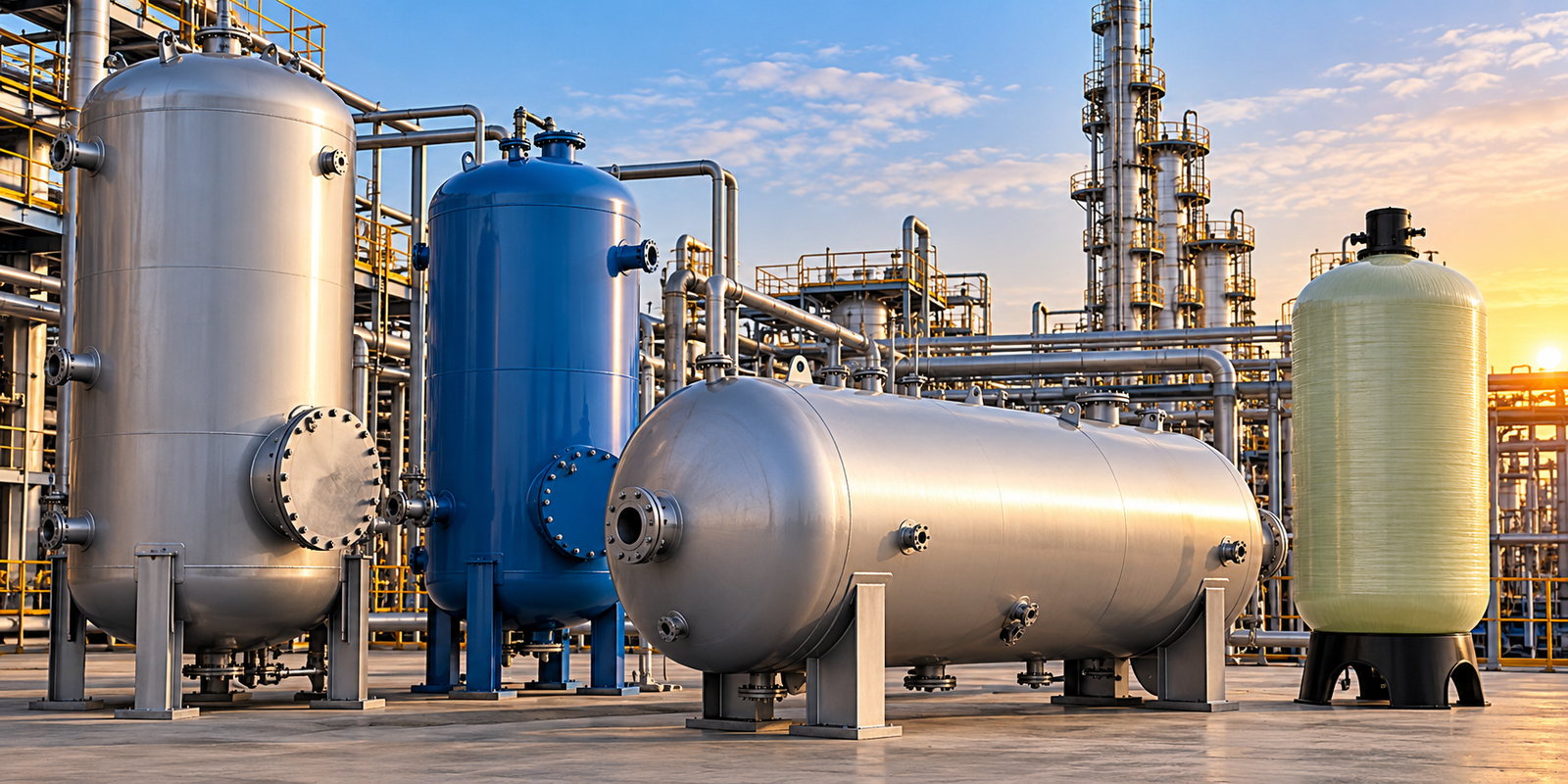
By shape. Cylindrical vessels, either vertical or horizontal, are the most common because a cylinder spreads stress evenly. Spherical vessels carry high pressure with thinner walls and suit large gas storage. Conical and combined-shape vessels appear in process units where flow or draining matters.
By function.Storage vessels contain the product, Process vessels are the reactors, separators, and columns where the actual processing occurs, Heat transfer vessels include shell and tube heat exchangers and jacketed vessels, Filtration vessels contain media such as sand, activated carbon or resin.
By material. Carbon steel handles most general duty. Stainless steel (304, 316L) suits food, pharma, and corrosive service. Alloys such as duplex steel go into severe chemical or high-temperature use. Composite construction covers the next category.
FRP Pressure Vessel: Where Composite Makes Sense
An FRP pressure vessel is made from a thin plastic liner wound with glass fibre and resin. It is common in water softeners, RO pre-treatment, and DM plants. The reasons are practical: it does not rust, it is light enough to handle without heavy lifting gear, and it resists many mild chemicals.
The limits are equally real. FRP is not suited to high temperatures or high pressure ranges the way a steel shell is. For standard water treatment pressures it works very well, but for steam, hot oil, or aggressive solvents, a metal vessel is the correct answer. A trustworthy manufacturer will tell you this instead of selling whatever is in stock.
ASME Pressure Vessel Code: Why It Matters
The ASME pressure vessel code means Section VIII of the ASME Boiler and Pressure Vessel Code. Division 1 uses rule-based design formulas and is the one most Indian projects follow. Division 2 allows design-by-analysis, giving thinner walls at higher pressures but demanding more engineering and documentation.
Code compliance covers more than wall thickness. It governs material selection, welding procedures, welder qualification, nondestructive examination, and final testing. In India, you will also meet the Indian Boiler Regulations for certain steam applications and the Pressure Equipment Directive when exporting to Europe. Many plant owners and inspection agencies ask for ASME-based design even on domestic projects.
When a supplier says "as per ASME," ask which section, which division, and whether the vessel will be stamped. A claim of following the code is different from being certified under it.
Pressure Vessel Testing: What Should Actually Happen
Pressure vessel testing is where claims meet proof. A properly built vessel typically goes through several checks:
- Material verification against mill test certificates before fabrication starts.
- Weld inspection using visual checks, dye penetrant, radiography, or ultrasonic testing, depending on design.
- Hydrostatic test, where the vessel is filled with water and pressurised above design pressure, commonly around 1.3 to 1.5 times, as the governing code specifies.
- Pneumatic test, used only when water is unsuitable, and handled with extra caution because stored gas energy is far higher.
- Dimensional and final documentation review, including data report and nameplate details.
Ask to witness the hydro test, or to have a third-party inspector do so. A manufacturer confident in its work will welcome that request.
Pressure Vessels in India: The Current Picture
Pressure vessels in India are driven by chemical, pharmaceutical, power, oil and gas, food processing, and water treatment industries. Fabrication clusters in Gujarat, Maharashtra, Tamil Nadu, and the Delhi NCR belt serve both domestic buyers and export clients.
The market has capable fabricators and plenty of workshop-level operators. The gap between them shows up in documentation, welding discipline, and traceability. Indian buyers increasingly ask for full material traceability and third-party inspection, which is a healthy trend.
How to Choose a Pressure Vessel Manufacturer
Skip the brochure language and test the supplier on specifics.
- Certifications. Look for ASME U-stamp capability where required, ISO 9001, and welders qualified to recognised procedures.
- Design capability. Can they produce calculations, drawings, and a design basis, or do they only copy your sketch?
- Material traceability. Every plate, nozzle, and flange should link back to a test certificate.
- Inspection access. Confirm you or your inspector can visit the shop and witness tests.
- Reference projects. Ask for similar vessels in your industry, ideally with a contact you can call.
- After-sales support. Spare gaskets, requalification advice, and repair help matter over a 15 to 20 year vessel life.
- Price against scope. A low quote that leaves out radiography, documentation, or surface treatment is not actually low.
The Anomizer Approach
At Anomizer, we treat every vessel as a pressure-bearing component first and a product second. Our process starts with the operating conditions: pressure, temperature, fluid, and cycle. We then select material and design basis around them, instead of fitting your requirement to a standard model. Testing and documentation are shared with the customer, because a vessel with no paperwork is hard to defend in an audit.
Whether you need a fabricated carbon steel receiver, a stainless steel process vessel, or guidance on when FRP is the smarter option, we start with the duty conditions and work outward.