


Design of Pressure Vessel is among the most crucial engineering practices in the industries including oil & gas, pharmaceutical, chemical, food processing, power generation, water treatment and manufacturing industries. A proper design of pressure vessel assures operational safety, efficiency, longevity and compliance with the engineering standards across the world.
For any industrial venture you undertake be it new or replacement of your old setup, it is imperative to know what pressure vessel design entails and how it should be done, tested and fabricated. Modern industries rely on pressure vessels engineered according to safety standards such as ASME Pressure Vessel Code and Boiler and Pressure Vessel Code.
Being among the leading pressure vessel manufacturers in India, we deliver highly customized pressure vessels for industries all over India.
What Is Pressure Vessel?
A pressure vessel is a specialized vessel that is fabricated with a specific purpose of storing liquids, gases, and vapors at pressures considerably different than the ambient atmospheric pressure. These pressure vessels are widely employed in many industrial processes where controlling pressure is important for safety reasons and efficient production.
The following industries use pressure vessels:
- Chemical Industry
- Pharmaceutical Industry
- Oil & Gas
- Food & Beverage
- Water Treatment
- Fertilizer Industry
- Petrochemical Industry
- Power Plants
Design of a proper pressure vessel will ensure safety during the process.
Principles in Pressure Vessel Design
The design of a pressure vessel entails complex engineering computations, materials selection, fabrication skills, and compliance with codes in various countries around the world.
Some of the essential considerations during the design of a pressure vessel are:
Operating internal and external pressures
- Design temperature
- Materials selection
- Corrosion allowance
- Joint efficiency
- Configuration of nozzles
- Support
- Construction
- Welding
- Safety factors
ASME pressure vessel code compliance is essential in all designs.
Pressure Vessel Types
The appropriate type of pressure vessel must be selected based on the industrial application.
Some of the common types of pressure vessels are as follows:
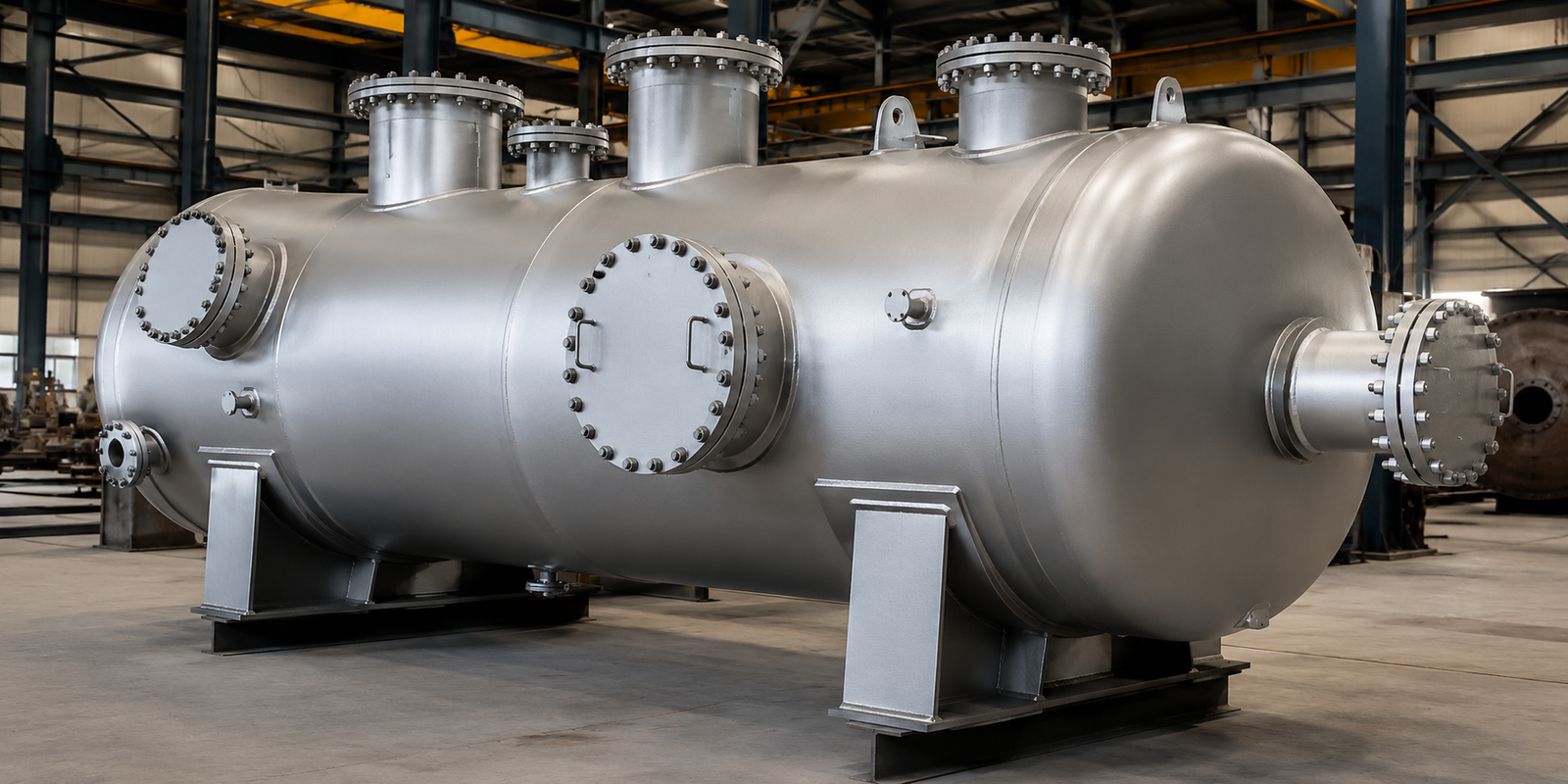
Horizontal Pressure Vessel
Extensively employed in storing gases and fluids in the chemical and petrochemical industry.
Vertical Pressure Vessel
Suited for installations where there is little space available and the process applications.
Spherical Pressure Vessel
Designed for the purpose of storing high-pressure gases with uniform stress levels.
Cylindrical Pressure Vessel
Most commonly designed in the industry because of their strength, ease of manufacturing, and economy.
Components of Pressure Vessel
The pressure vessel is comprised of many well-made parts such as:
- Shell
- Heads
- Nozzles
- Flanges
- Supports
- Manway
- Reinforcement Pads
- Gaskets
- Relief Safety Valve
- Instrument Connections
Good quality pressure vessel parts add value to safety and maintenance.
Pressure Vessel Thickness Calculation
Pressure vessel thickness calculation is one of the most significant aspects of vessel engineering.
The wall thickness of a pressure vessel is calculated using the following factors:
- Internal pressure
- Diameter of the pressure vessel
- Material properties
- Allowance for corrosion
- Joint efficiency
- Temperature of design
Design code applicable to that specific vessel.
Process for Pressure Vessel Manufacturing
After the engineering design has been confirmed, manufacture takes place with strict quality assurance guidelines.
Typically, the process for manufacturing a pressure vessel consists of:
- Inspection of materials
- Plate cutting
- Bending/Rolling
- Welding
- Annealing/heat treatment
- Non-Destructive Testing (NDT)
- Surface finishings
- Hydro testing
- Final inspection
- Documentation
Manufacture will always ensure quality and long-lasting construction to meet international standards.
Drawing of Pressure Vessel and Diagram
A detailed drawing of a pressure vessel gives all the needed manufacturing data before the manufacturing process commences.
Engineering drawings will usually consist of:
- Dimensions of vessel
- Orientation of nozzles
- Welding spots
- Material data
- Information on supports
- Notes on manufacture
In a similar manner, a pressure vessel diagram will be useful for engineers, inspectors and maintenance crew.
Pressure Vessel Testing
Prior to any project commissioning, all vessels are subjected to pressure vessel testing in order to ensure the safety of the vessels.
Types of testing include:
- Hydrostatic Testing
- Pneumatic Testing
- Ultrasonic Testing
- Radiographic Testing
- Dye Penetrant Testing
- Magnetic Particle Testing
- Visual Testing
Boiler and Pressure Vessel Code
The Boiler and Pressure Vessel Code provides international engineering standards for the design, manufacture, inspection, and testing of pressure vessels.
This code can assist manufacturers to have:
- Increased safety in operations
- Compliance with regulations
- Reliability in performance
- Minimal maintenance risks
- High quality products
ASME Pressure Vessel Code
ASME Pressure Vessel Code is considered one of the most reputable engineering standards worldwide.
It includes:
- Calculation design
- Material designation
- Welding procedures
- Inspection process
- Testing procedures
- Certification process
- Quality assurance
Pressure vessels built on ASME standards are characterized by safety, longevity, and international acceptance.
Why Choose Anomizer for Pressure Vessel Design?
We, at Anomizer, focus on manufacturing high-end pressure vessels designed for various industrial purposes.
Our benefits include:
- Custom-made solutions
- ASME approved design techniques
- Construction from top-quality stainless steel/carbon steel materials
- Sophisticated production facilities
- Professional engineering staff
- Thorough quality inspections
- Punctual delivery of your order
- Service provided all over India and abroad
Industries can benefit from our solutions and increase their productivity safely.
Conclusion
The design of the pressure vessel is an important part of safe and successful industrial activities. All stages are important, including the choice of materials, calculations of the pressure vessel thickness, adherence to the Boiler and Pressure Vessel Code, and ASME Pressure Vessel Code.
In case of need for customized pressure vessels for various purposes, from chemical engineering to food manufacturing and energy sector, you should cooperate with professionals.
Contact Anomizer Today!
Looking for quality engineering services in pressure vessel designing?
We at Anomizer provide customized designs of pressure vessels built according to international standards that are specially made to meet the needs of different industries both in India and other parts of the world. We use the expertise of our professional engineers in designing efficient and effective pressure vessels for your processes.