


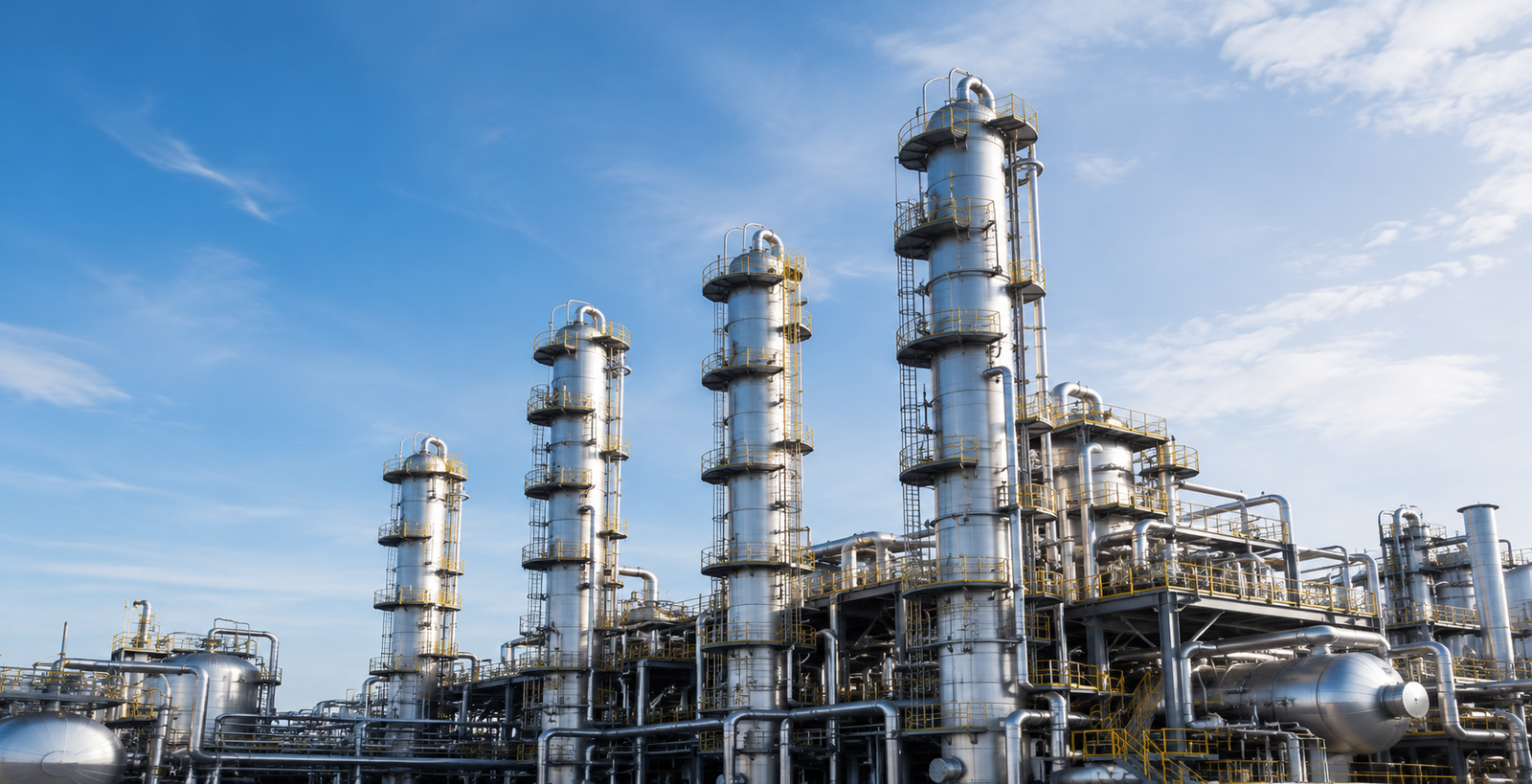
Any process engineer will tell you the equipment he or she values the most, and it is very likely the distillation column will be named. This equipment is not difficult to recognize externally – a tall cylinder that may stand a few storeys tall – however, internally, the distillation column is performing an amazing task – separating a liquid mixture using heat and gravity.
I've spent years around refineries and chemical plants, and if there's one thing I'd want every engineering student to understand before they touch a P&ID, it's how this column actually works. So let's go through it properly — not the dry textbook version, but the way it plays out on a real plant floor.
So, What Is a Distillation Column, Really?
Essentially, the separation process involves a mixture of liquids separated into their individual parts based on a single basic principle that the boiling points of all the components in the mixture are different. When heated, the most volatile substances evaporate first. The heavier stuff stays liquid and drops. Repeat that vaporization-condensation cycle enough times as the mixture climbs the column, and you end up with clean, separated products at different points along its height.
This is exactly why distillation column petroleum applications are so massive — crude oil isn't one substance, it's a soup of hydrocarbons with wildly different boiling points, and refineries rely on distillation to untangle it into petrol, diesel, kerosene, and everything in between.
Reading a Distillation Column Diagram
Before you can design one, you need to be able to picture one. A basic distillation column diagram usually shows:
- The feed inlet, where the mixture enters
- A reboiler at the bottom, boiling the liquid to create rising vapor
- A condenser up top, turning vapor back into liquid
- The reflux loop, sending some of that liquid back down to sharpen the separation
- Internal trays or packing, where the real vapor-liquid contact happens
- Downcomers, the pathways liquid uses to travel from one level to the next
Once you can trace vapor going up and liquid coming down on that diagram, the rest of the theory starts to click.
The Main Types of Distillation Column
There are two broad types of distillation column you'll come across:
- Tray columns, which use horizontal plates stacked inside the vessel
- Packed columns, which use loose or structured packing material instead
Beyond that, columns also get grouped by how they run — batch or continuous — and by their job, like fractional, vacuum, azeotropic, or extractive distillation. Which one you pick depends heavily on the mixture, the pressure you're working at, and how sharp the separation needs to be.
Why the Fractional Distillation Column Gets Special Treatment
When boiling points are close together, a basic single-stage setup just won't cut it. That's where a fractional distillation column comes in — it stacks many theoretical separation stages inside one vessel, letting you pull apart components that would otherwise blend right back together. Refineries lean on this heavily to split crude oil into its major fractions in one continuous run.
Packed Distillation Column and Packing Choices
A packed distillation column skips trays entirely and instead fills the vessel with material that maximizes surface contact between rising vapor and falling liquid. It's a favorite for vacuum service and smaller-diameter columns because of its lower pressure drop.
When it comes to types of packing in distillation column setups, you're choosing between:
- Random packing — Raschig rings, Pall rings, Berl saddles — dumped in and settling naturally
- Structured packing — precision-arranged sheets that deliver higher efficiency, often at a higher cost
Neither is universally "better." It genuinely comes down to your fouling risk, your capacity needs, and your budget.
Tray Types Worth Knowing
If you go the tray route, you'll be choosing among the common types of trays in distillation column design:
- Sieve trays — perforated, simple, and cheap, which is why they're everywhere
- Valve trays — with movable caps that adjust to varying vapor loads
- Bubble cap trays — older, pricier, but excellent vapor-liquid contact where it's needed
What Goes Into Distillation Column Design
Good distillation column design isn't guesswork — it's a stack of interconnected decisions: number of theoretical stages, reflux ratio, column diameter and height, where the feed enters, tray spacing or packing depth, and what materials can survive the process fluid without corroding.
All of that ends up documented in a distillation column specification sheet, which becomes the go-to reference for fabrication, procurement, and the operators who'll run the thing for years afterward. Get this document wrong, and the mistakes follow you into commissioning.
Flooding and Entrainment: The Two Problems Every Operator Fears
Push a column too hard, and you'll run into flooding in distillation column operation — vapor moving so fast upward that liquid can't drain down properly anymore. It backs up, separation efficiency collapses, and in bad cases, you risk damaging the internals.
Closely tied to this is entrainment in distillation column behavior, where liquid droplets get physically carried upward by the vapor before full flooding even sets in. It quietly erodes tray efficiency and can contaminate your overhead product long before anyone notices flooding on the pressure gauges.
A well-sized downcomer in distillation column design is one of the best defenses against both problems — giving liquid enough time and space to flow down without choking the system.
Thinking Through Your Own Column Design?
Distillation columns reward careful thinking and punish shortcuts — a column that's slightly undersized or poorly specified has a way of causing headaches for years. If you're working through design calculations, drafting a specification sheet, or troubleshooting flooding or entrainment on an existing unit, talk to a process engineering specialist before you finalize anything — it's a lot cheaper to fix on paper than in steel.