


Quick Answer
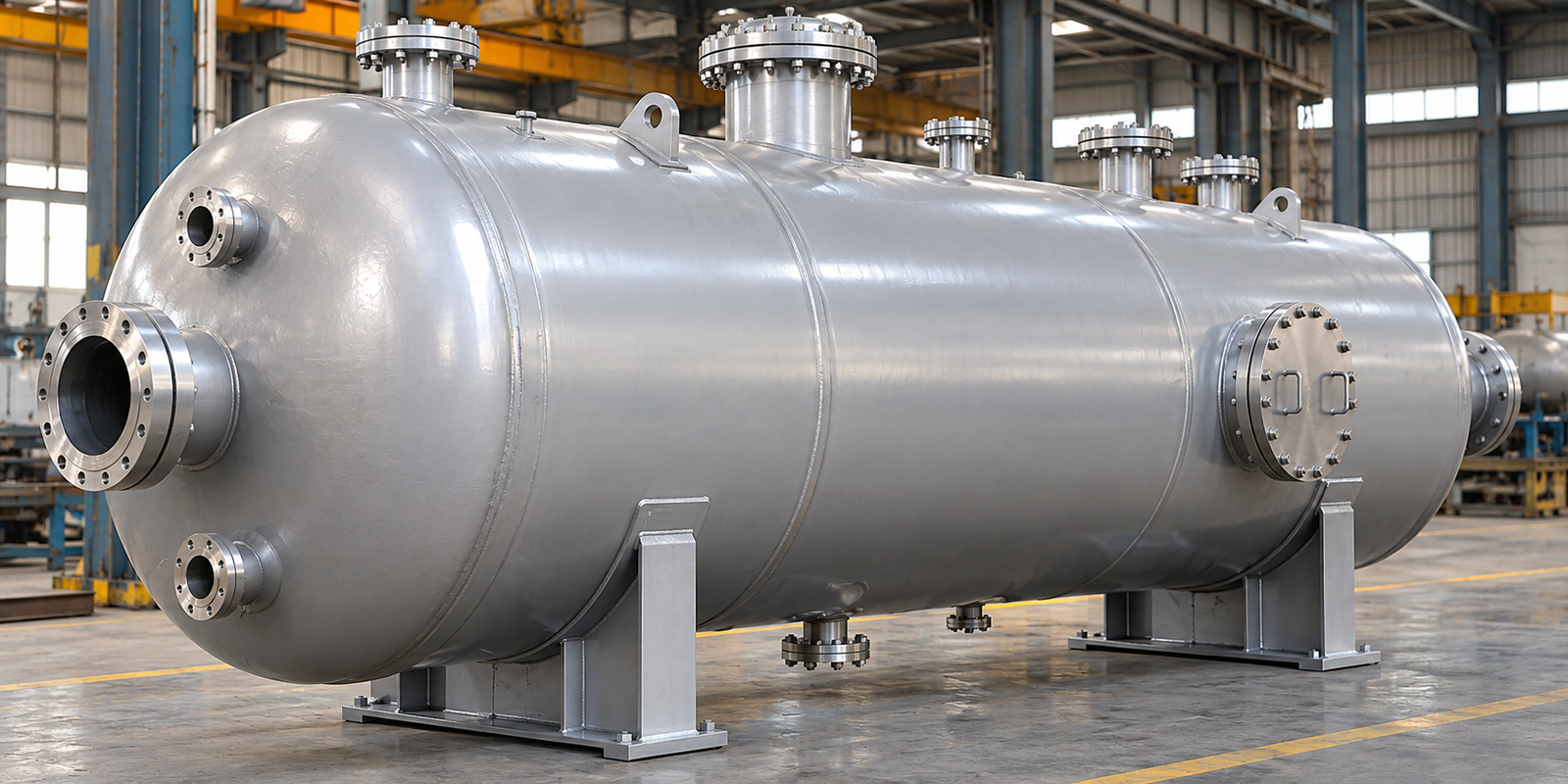
A pressure vessel tank is a sealed container built to hold gases or liquids at pressure well above atmospheric levels. Getting that right means calculating wall thickness correctly, reinforcing every opening, and following codes such as ASME Section VIII so the vessel never becomes a rupture risk. No vessel leaves the shop without a hydrostatic test to prove it can handle more than its rated pressure.
If you've ever walked through a plant and noticed a squat cylindrical tank humming quietly near the compressors, or a tall column running the height of a distillation unit, you've seen a pressure vessel at work. Most people never think about them until something goes wrong, and that's kind of the point — when they're built right, they just sit there doing their job for decades.
At Anomizer.com, we spend a lot of time talking to process engineers and procurement teams who are tired of vendors who treat "code compliant" as a marketing line rather than an engineering reality. So this guide is meant to be practical: what a pressure vessel actually is, how it gets designed, what the different types are for, and which codes actually govern whether a tank should be trusted with your process.
What Is a Pressure Vessel, Really?
Strip away the jargon and a pressure vessel is just a container built to hold something at a pressure meaningfully different from the air around it. That's the whole distinguishing feature. An ordinary storage tank doesn't have to fight back against internal force pushing outward on every square inch of its shell — a pressure vessel does, constantly, for as long as it's in service.
That constant outward push is why the shell, the heads, the nozzles, and especially the welds have to be engineered rather than just assembled. A tank that would sit unpressurized for a century without issue can fail in seconds once pressure is added, if the design didn't account for it.
You'll find pressure vessels almost anywhere gas or liquid needs to be compressed, stored, or reacted: air receivers on compressor systems, boilers generating steam, autoclaves used for sterilization or composite curing, LPG and ammonia storage, distillation columns, chemical reactors. Different jobs, same underlying problem — contain the pressure, safely and for the long haul, without over-engineering the cost out of the project.
How Pressure Vessel Design Actually Happens
There's no single formula that spits out a finished design. It's more of a chain, where each decision constrains the next.
It starts with the design basis — the maximum allowable working pressure, the design temperature, how corrosive or abrasive the contents are, and how long the vessel needs to last. Everything downstream gets measured against these numbers.
Next comes shape. Cylindrical shells paired with hemispherical, elliptical, or torispherical heads dominate the industry because curved surfaces spread pressure evenly. Flat surfaces concentrate stress in ways that curved ones don't. From there, engineers calculate wall thickness so the hoop stress and longitudinal stress stay within what the chosen material can safely carry, then add a corrosion allowance on top for however long the vessel is expected to run.
Material choice follows from what's actually being stored. Carbon steel handles a lot of general-purpose work. Stainless steel, low-alloy steel, and clad or duplex materials come into play when the contents are more aggressive — ammonia service calls for different metallurgy than compressed air, for instance.
Every nozzle, manway, or instrumentation port cut into the shell removes material that used to be carrying load, so it needs reinforcement — usually a pad or a thicker local section — or it becomes the weak point that eventually fails first.
Welding is where a lot of vessels succeed or fail in practice, not just on paper. Full penetration welds, controlled heat input, and post-weld heat treatment aren't optional extras on thicker or higher-pressure vessels; they're what keeps the weld from being the failure origin.
Before anything goes into service, it gets checked. Radiography, ultrasonic testing, and dye penetrant inspection catch flaws no one could see with the naked eye. Then comes the hydrostatic test — pressurizing the finished vessel to somewhere between 1.3 and 1.5 times its design pressure — the final proof that it can handle more than it'll ever actually see in operation.
Types of Pressure Vessel
Pressure vessels aren't one-size-fits-all. A few of the categories you'll run into most:
- Storage vessels hold compressed or liquefied gases — LPG, ammonia, nitrogen, and similar.
- Process vessels — reactors, separators, columns — are where a chemical or physical reaction actually happens under pressure.
- Heat exchange vessels, like shell-and-tube exchangers, contain pressure and move heat at the same time.
- Boilers and steam drums generate or hold pressurized steam and tend to face the strictest inspection schedules of the bunch.
- Autoclaves apply pressure and heat together, common in sterilization and composite manufacturing.
Beyond function, vessels also get classified by orientation (horizontal versus vertical), by how the wall is built (single-wall, jacketed, multi-layer), and by which design code governs them — which is really the backbone of the whole industry.
Why the Boiler and Pressure Vessel Code Exists
"Boiler and pressure vessel code" refers to the rulebook — design, fabrication, inspection, maintenance — that governs this equipment. The reason these codes are so strict comes down to how pressure vessels tend to fail: not gradually, but suddenly, releasing stored energy all at once. Codes exist to standardize allowable stresses, minimum thicknesses, and documentation so a vessel built in one country can still be trusted by an inspector on the other side of the world.
The ASME Pressure Vessel Code
Of all the standards out there, the ASME Boiler and Pressure Vessel Code is the one referenced most often worldwide. Section VIII covers pressure vessels specifically and splits into three divisions. Division 1 uses simpler, conservative rules and is what most standard industrial vessels are built to. Division 2 permits more detailed stress analysis — it can save material, but it demands more rigorous engineering behind it. Division 3 handles the very high-pressure, specialized end of the spectrum.
A manufacturer carrying the ASME "U" stamp has been through an audit process proving their design, fabrication, and quality systems actually hold up. For a buyer, that stamp is one of the clearest signals you'll get that a vendor isn't just claiming compliance.
Picking a Pressure Vessel Manufacturer in India
India has quietly become one of the major fabrication hubs for pressure vessels, supplying not just domestic industry but export markets across the Middle East, Africa, and Southeast Asia. If you're evaluating a pressure vessel manufacturer in India, a handful of things separate the ones worth trusting from the ones worth avoiding: real in-house design and stress analysis capability, welders with documented certifications and procedures, willingness to bring in third-party inspectors, an actual track record of ASME (or equivalent) compliance, and material traceability you can follow from the raw plate to the finished vessel.
A manufacturer worth working with will walk you through the design basis rather than just handing over a drawing, and they won't flinch at third-party inspection — if anything, they'll welcome it. That openness tends to say more about a manufacturer than any brochure could.
Final Thoughts
At the end of the day, a pressure vessel is only as good as the thinking that went into it before the first weld was struck. Whether you're specifying a new storage vessel, replacing something aging, or vetting a manufacturer for the first time, the design principles and code framework covered here should give you a better set of questions to ask — and a better sense of what a real answer sounds like. At Anomizer.com, this is the standard we hold every project to: sound design, verified materials, code-compliant fabrication, no shortcuts.