


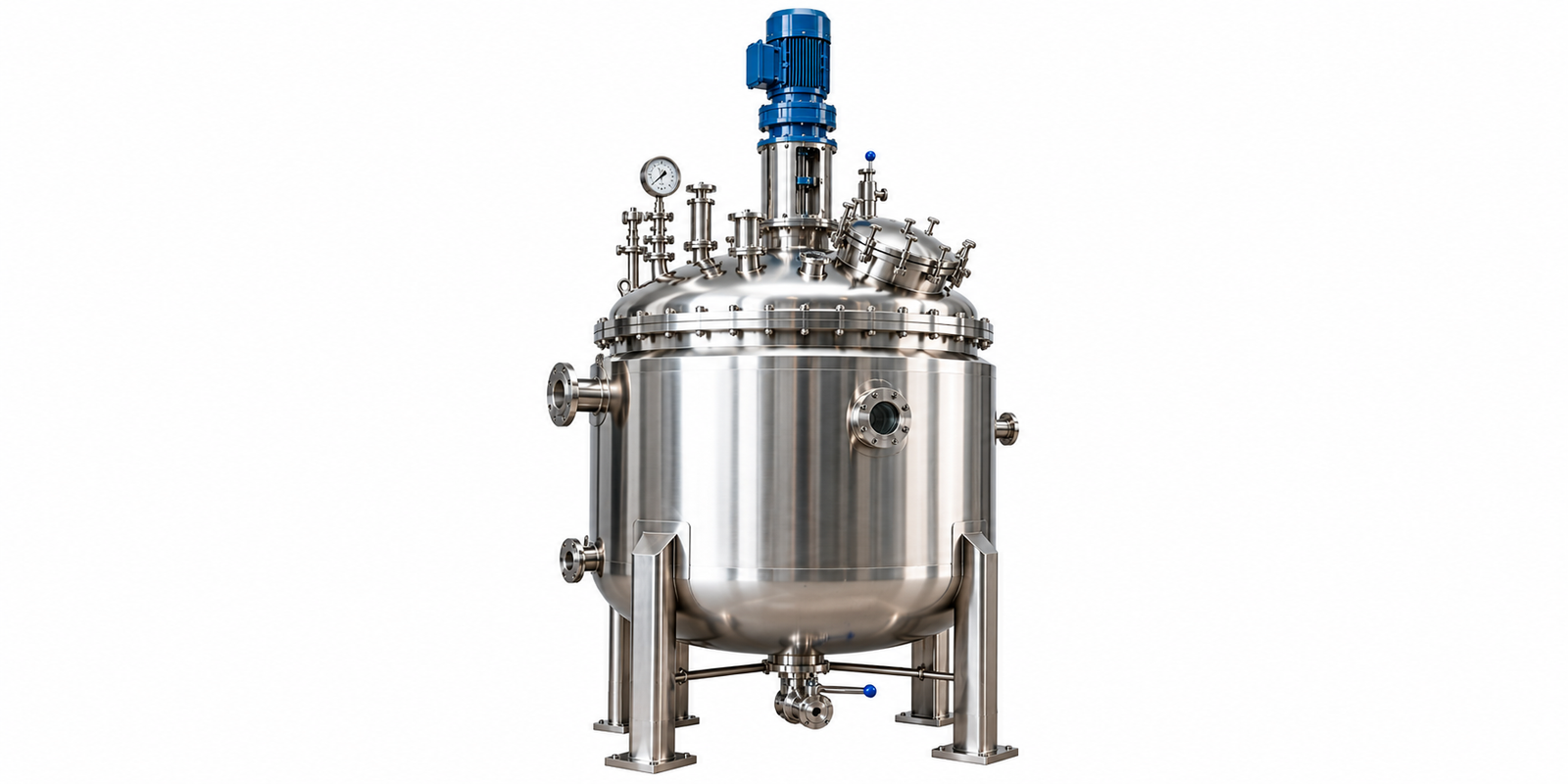
Buying a reaction vessel is rarely a catalogue exercise. The vessel sits at the centre of your process, so a wrong choice shows up later as poor yield, uneven heating, leaking seals or a shutdown you did not plan for. This guide covers what a good reaction vessel supplier should be able to explain, and where Anomizer fits in.
What a Reaction Vessel Actually Does
A reaction vessel is a closed, controlled container in which raw materials are mixed, heated or cooled, and allowed to react under set conditions of temperature, pressure and time. Pharmaceutical intermediates, specialty chemicals, resins, dyes, agrochemicals and food-grade formulations all depend on it.
The vessel is not a tank. A storage tank holds material. A chemical reactor vessel has to manage the reaction itself: it controls heat release, keeps the contents uniform, and contains pressure or vacuum safely.
Reaction Vessel Working Principle
The working principle comes down to three things happening together.
- Charging: Reactants enter through the top nozzles or a charging port, in a sequence your process dictates.
- Mixing and heat transfer: An agitator keeps the batch uniform while a jacket or coil carries heat in or out.
- Control and discharge: Temperature, pressure and time are monitored, and the product leaves through a bottom outlet valve once the reaction is complete.
Heat transfer is the part that most often goes wrong. An exothermic reaction that cannot shed heat quickly enough creates hot spots, side products and, in the worst case, a runaway. That is why jacket design deserves as much attention as vessel volume.
Types of Reaction Vessels
Choosing among the types of reaction vessels depends on your chemistry, not on habit.
- Jacketed reaction vessel: An outer shell surrounds the main vessel, and steam, thermal oil, hot water or chilled brine circulates in the gap. This is the most common industrial format.
- Half-coil jacketed vessel: Half-pipe coils are welded to the outside. They handle higher pressures in the heating medium and give faster, more directed flow.
- Limpet coil vessel: Similar in purpose, used where the service pressure on the jacket side is high.
- Pressure reactors: Built to ASME-style design codes for reactions that run above atmospheric pressure.
- Vacuum-rated vessels: Used for distillation, drying and reactions where solvent removal matters.
- Glass-lined and SS 316 vessels: Chosen according to how corrosive your reactants are. SS 304 suits milder service, SS 316 or 316L handles chlorides and many acids better, and glass lining suits aggressive acidic media.
Reaction Vessel with Agitator: Getting the Mixing Right
A reaction vessel with agitator is only as good as the match between impeller and material. Many buyers choose the vessel first and treat the agitator as an accessory. That is backwards.
- Anchor agitators suit viscous batches and scrape the wall to improve heat transfer.
- Pitched blade turbines give good axial flow for general liquid blending.
- Flat blade or Rushton turbines shear gas into liquid or disperse immiscible phases.
- Helical ribbon agitators work with very thick, paste-like products.
Ask your supplier about shaft sealing too. A mechanical seal with a proper flush plan costs more than gland packing, but it saves you from leaks and contamination, which matters in pharma and food-grade work.
Reaction Vessel Design: The Points That Matter
Good reaction vessel design starts with your process, not the vessel. Before any drawing is made, a competent supplier should ask about:
- Batch size and working volume, including headspace for foaming or expansion
- Operating and design temperature and pressure, including vacuum
- Viscosity and density of the batch, which drive agitator power
- Corrosiveness of every chemical, including cleaning agents
- Heating and cooling duty, and how fast you need to ramp
- Surface finish requirements, especially for pharma and food use
- Hazardous area classification, if flammable solvents are involved
Material of construction, wall thickness, weld quality, nozzle layout and instrumentation ports all follow from these answers. A supplier who quotes before asking them is quoting a generic vessel.
Reaction Vessel Applications
Reaction vessel applications cut across industries:
- Pharmaceuticals: API synthesis, crystallisation and intermediate production
- Specialty and fine chemicals: Esterification, nitration, sulphonation, polymerisation
- Paints, resins and adhesives: Controlled polymerisation and blending
- Agrochemicals: Formulation and synthesis of active ingredients
- Cosmetics and personal care: Emulsions and gels under controlled temperature
- Food and beverage processing: Cooking, blending and heat-sensitive formulations
How to Evaluate a Reaction Vessel Supplier in India
The market for reaction vessel suppliers in India is large, and quality varies a lot. A few checks separate a dependable partner from a trading intermediary.
Manufacturing capability. Ask whether fabrication is in-house or outsourced. In-house control over cutting, rolling, welding and polishing means better accountability when something needs correcting.
Material traceability. Genuine suppliers provide mill test certificates for the stainless steel they use. If a supplier cannot show them, treat that as a warning.
Weld quality and testing. Look for hydrostatic testing, dye penetrant checks and documented weld procedures. For pressure service, ask which design code the vessel follows.
Documentation. General arrangement drawings, calculations, inspection reports and a clear warranty should come with the vessel, not after repeated requests.
Customisation. Your process is specific. A good supplier adjusts jacket type, agitator, nozzles and instrumentation instead of pushing a fixed model.
After-sales support. Spares, seal replacements and service response time matter long after the invoice is paid.
Why Buyers Look at Anomizer
Anomizer focuses on industrial reactor vessel fabrication built around the buyer's process rather than a standard catalogue. The approach is straightforward: understand the chemistry, size the vessel and jacket for the real heat duty, select the agitator for the batch viscosity, and document everything.
Our vessels are built in stainless steel grades chosen for the service, with finishes suited to pharma, chemical and food applications. Each unit goes through inspection and pressure testing before dispatch, and our team stays available for commissioning questions and spare parts.
If you are comparing quotes, send us your batch size, temperature and pressure range and chemical list. A short technical discussion usually saves weeks of back-and-forth later.