


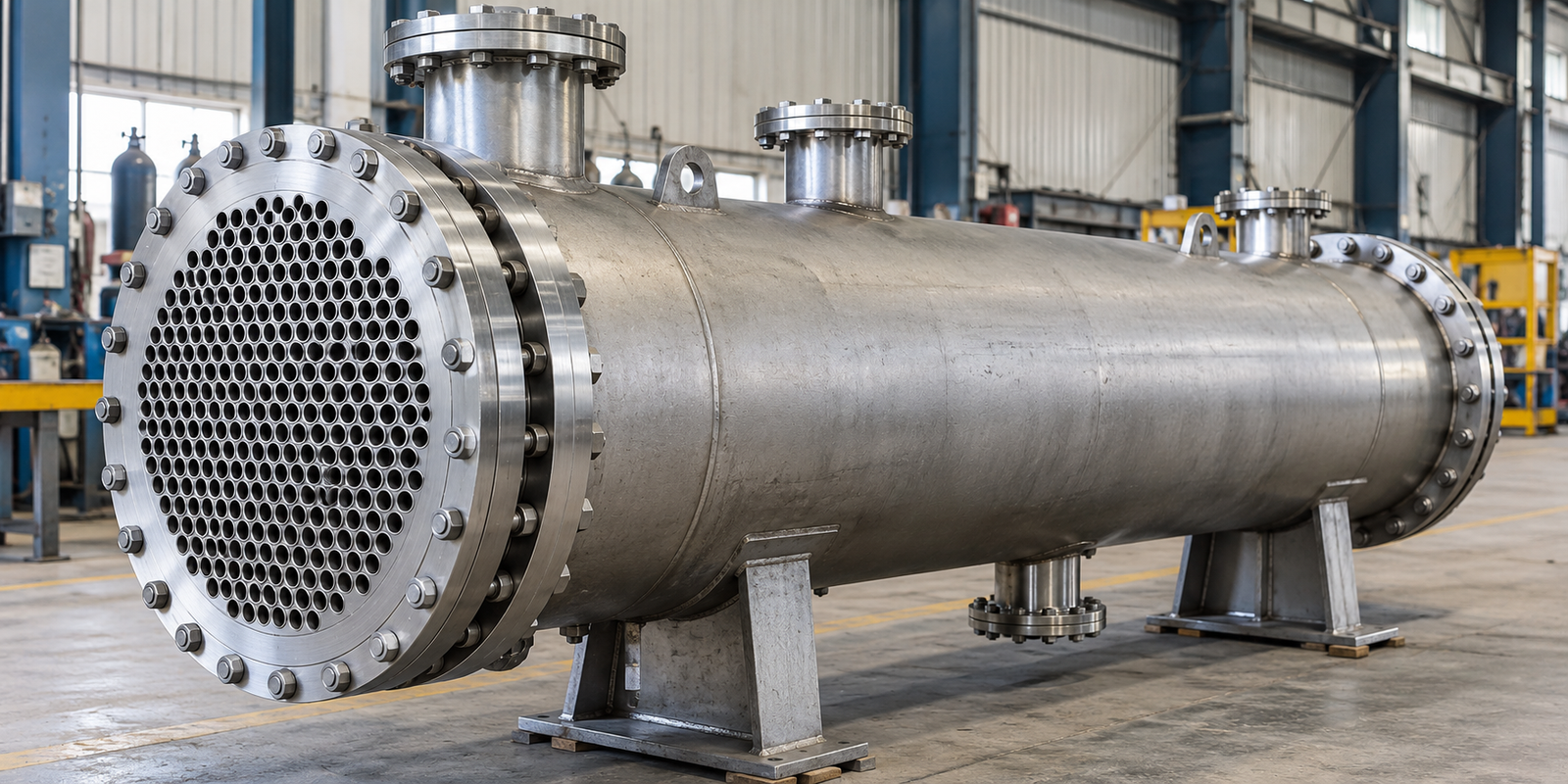
Quick Answer: The best heat exchanger manufacturer in India is the one whose design codes, material expertise and testing match your fluid and duty. Check for TEMA and ASME compliance, mill test certificates, in-house testing and a similar past application, then compare three suppliers on the same datasheet.
Ask five plant engineers to name the best heat exchanger manufacturer in India and you will hear five different answers. That isn't indecision. "Best" depends on what flows through the unit. A maker that builds excellent brazed plate exchangers for chillers may be the wrong choice for a hydrochloric acid cooler. This guide skips the ranking and shows how to judge a manufacturer on evidence, material by material, so your shortlist holds up when someone questions it.
What "Best" Really Means
Four things separate a real manufacturer from a trader who forwards drawings:
- Design code compliance. Shell-and-tube units should be designed to TEMA and ASME Section VIII Division 1. If the exchanger sits in a steam circuit in India, ask about IBR approval as well.
- Material traceability. Every plate, tube and tubesheet should arrive with a mill test certificate, and the manufacturer should be willing to run positive material identification (PMI) on it.
- In-house testing. Look for hydrostatic testing and dye penetrant checks on welds. Helium leak testing and radiography should be available where the duty demands them.
- Application history. A logo wall proves little. A serious manufacturer can walk you through a past job similar to yours, including what went wrong and what they changed.
Titanium Heat Exchanger Manufacturer in India
Titanium earns its cost where chlorides, seawater or wet chlorine would pit stainless steel within months. Desalination, chlor-alkali plants, marine cooling loops and some dye-intermediate lines fall in this group. Commercially pure Grade 1 and Grade 2 cover most duties.
Buyers usually get this wrong in one of two ways. They order titanium where 316L or duplex would last just as long, or they save money with 316L on a warm chloride stream and pay for retubing later. A good titanium manufacturer asks for your chloride level and operating temperature before quoting, not after.
Best heat exchanger manufacturer in india
A brazed plate exchanger stacks thin stainless plates and bonds them with copper or nickel. The result is a small footprint and very high heat transfer, which is why these units dominate HVAC, refrigeration, heat pumps and oil cooling.
The trade-off is that you cannot open one for cleaning. Hard water, fibres or slurries will foul it for good. Copper-brazed units also suit ammonia and chloride-rich water poorly, so those services call for nickel-brazed or fully welded designs. Ask the manufacturer for the rated pressure and temperature on the nameplate, and check that the plate pattern suits your fluid viscosity.
Graphite Heat Exchanger Manufacturers in India
Impregnated graphite, usually phenolic or PTFE-treated, is the standard answer for hydrochloric, dilute sulphuric and phosphoric acid duties. Hot HCl attacks titanium, and graphite handles it. It also conducts heat better than most stainless steels.
Its limits matter as much as its strengths. Graphite is brittle, so thermal shock and pressure spikes need to be designed out. It is also unsuitable for strongly oxidising media such as concentrated nitric acid. Block-type and shell-and-tube graphite designs both exist. The right choice depends on how easily you need to clean it and the pressure you run at.
Heat Exchanger Tubes Manufacturers in India
Tubes take the abuse, so specify them carefully:
- Process: seamless (ASTM A213) or welded (ASTM A249) for austenitic grades.
- Grade: 304L, 316L, duplex 2205, 90/10 copper-nickel or titanium Grade 2.
- Shape: U-tubes and straight tubes are separate orders with different bundle designs.
- Testing: eddy current and hydro test reports for each lot.
A tube supplier who cannot state wall-thickness and ovality tolerances should not be feeding your bundle.
Largest Heat Exchanger Manufacturer in India
The answer changes with how you count: annual revenue, plant capacity, product range, or the physical size of the biggest unit supplied. Large groups with global parent companies tend to lead in plate exchanger volume. Big engineering houses lead in boilers and heat recovery. A long tail of specialist fabricators handles corrosion-resistant and custom work.
Size does not guarantee attention. A mid-sized specialist will often give a three-unit titanium order more care than a giant handling thousands of standard plates. Choose on fit to your duty, not on scale.
List of Heat Exchanger Manufacturers in India
A copy-pasted list of fifty names tells you very little. A shortlist of three works better:
- One large brand for standard plate units.
- One specialist in your fluid or material.
- One fabricator for custom shell-and-tube work.
Send all three the same datasheet: fluids, flow rates, inlet and outlet temperatures, design pressure, allowable pressure drop, fouling factor, material preference and applicable code. Compare the replies side by side. The quality of the questions they ask back will tell you more than the price does.
Why Choose Anomizer.com
At Anomizer.com we start from the fluid, not the catalogue. Send us the process conditions and we will come back with a material and design recommendation. That may be titanium, graphite, brazed plate or a stainless shell-and-tube. If a cheaper material will do the job, we will say so. A quote that fits the duty is worth more to your plant than the most expensive metal on the list.
Get Your Heat Exchanger Quote
Not sure which material or design suits your process? Share your fluids, flow rates, temperatures and pressure with the Anomizer.com team. We will review your datasheet and reply with a recommended material, design and quotation, built around your duty and not a standard catalogue.
Send your requirement to Anomizer.com today and get a heat exchanger that fits your process.