

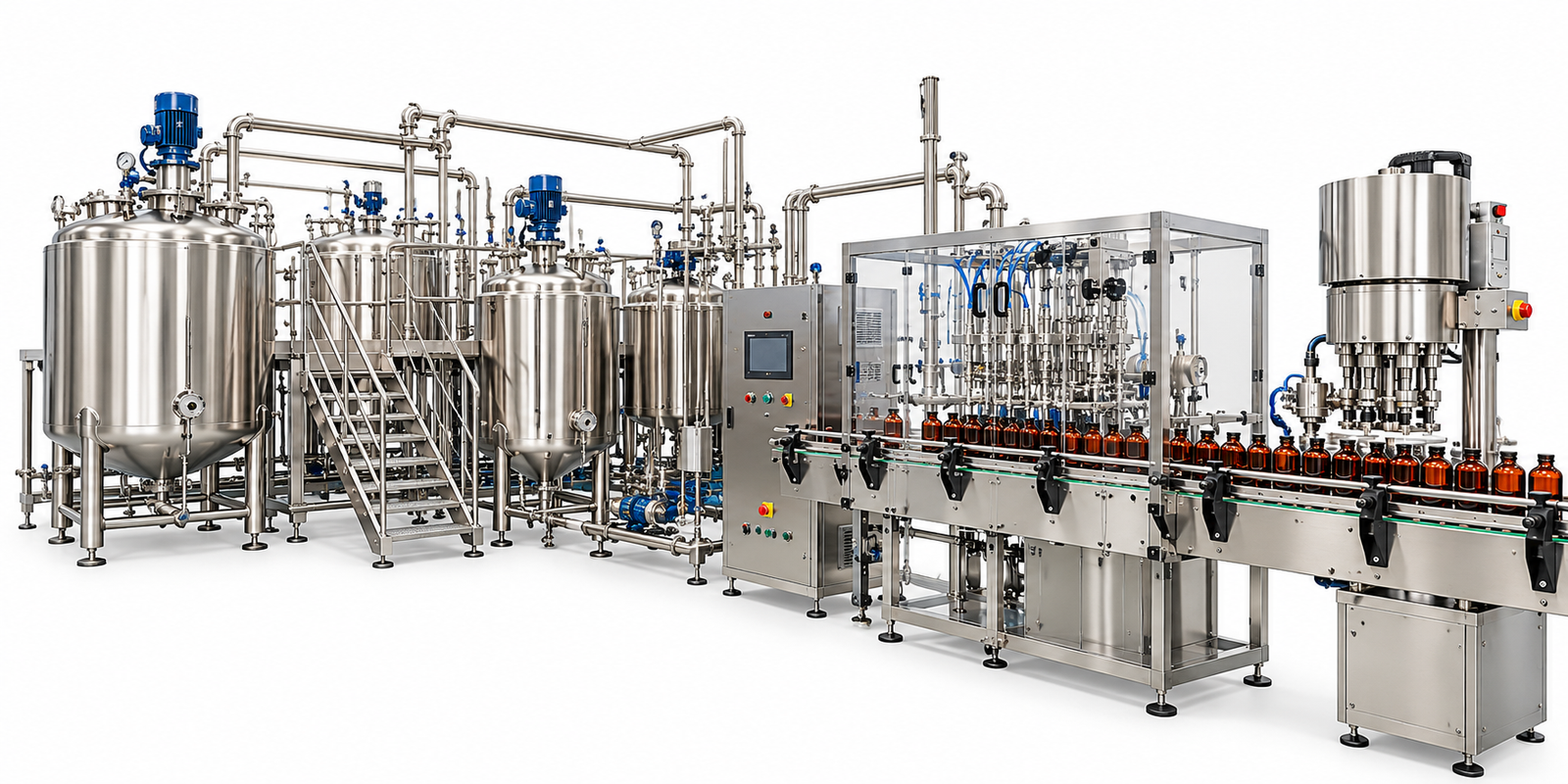
A liquid syrup production line is a connected set of machines that dissolves, mixes, filters, stores, fills, and seals oral liquids in one controlled flow. A good liquid syrup production line manufacturer designs that flow around your formulation, your batch size, and your regulator's expectations, rather than selling you a catalogue item. At Anomizer, most of our conversations start with the product (a sugar-heavy cough syrup, a suspension, a herbal tonic) and only then move to the equipment. If you want to see how we approach the full setup, our liquid syrup manufacturing plant page walks through it in more detail.
This guide covers what the line contains, how it gets installed, what drives cost, and the questions worth asking any supplier.
What Does a Liquid Syrup Production Line Include?
Every oral liquid manufacturing plant follows the same basic path, even when the size changes. The equipment sits in this order:
- Sugar dissolving vessel. A jacketed, steam-heated tank where sugar is dissolved in purified water. Temperature control matters here, because overheating inverts the sugar and darkens the syrup.
- Manufacturing (mixing) vessel. Actives, preservatives, flavours, and colours are added under agitation. Vessels with a high-shear homogenizer suit suspensions, while a simple anchor or paddle agitator handles clear syrups.
- Filtration system. Sparkle filters or filter-press assemblies remove undissolved particles before the product moves on.
- Transfer pumps and piping. Sanitary pumps and tri-clover fittings keep the product hygienic and prevent dead legs where bacteria collect.
- Storage or holding tank. The finished bulk waits here for QC release.
- Bottle washing, filling, capping, and labelling. In a liquid oral manufacturing line, this section decides your output per hour.
- CIP/SIP provisions. Clean-in-place and steam-in-place connections reduce manual cleaning and cross-contamination risk.
Product-contact parts are normally SS316L, with SS304 for non-contact frames and jackets. Surface finish on contact parts is usually polished to a level that cleaning validation can support.
Pharmaceutical Syrup Manufacturing Equipment: Where Quality Is Decided
Buyers often compare pharmaceutical syrup manufacturing equipment on capacity alone. In our experience, the details below cause more trouble after commissioning than raw size does.
Weld quality and finish. Rough internal welds trap residue. Ask to see a sample weld and the finish report before you place an order.
Agitator design. A poorly matched agitator leaves unmixed pockets in thick syrups. The viscosity of your product should drive the choice.
Documentation. A cGMP-aligned supplier provides material certificates, design qualification (DQ), and support for IQ/OQ. Without this paperwork, your audit becomes harder. Indian manufacturers should also keep the CDSCO GMP expectations in view while specifying equipment, since layout and finish choices feed directly into inspection readiness.
Layout. The line should work inside your existing room. A plant designed on paper but ignoring door widths, ceiling height, and utility points creates delays on site.
Automatic vs Semi-Automatic Syrup Manufacturing Plant
An automatic syrup manufacturing plant links vessels through a PLC panel. Temperature, agitator speed, transfer, and batch timing are recorded without an operator standing at each tank. This reduces batch-to-batch variation and gives you electronic records that auditors like to see.
A semi-automatic plant uses manual valves and operator-controlled steps. It costs less and suits smaller units, contract batches, or companies starting out. The honest answer for many first-time buyers is to begin semi-automatic with a layout that allows automation to be added later, rather than overspending on day one.
Cough Syrup Manufacturing Plant: Special Considerations
A cough syrup manufacturing plant faces a few extra constraints. Many formulas contain high sugar concentrations, alcohol, or sensitive actives such as antihistamines. That affects three choices:
- Material compatibility. Alcohol-containing formulas need gaskets and seals rated for them.
- Heat control. Some actives degrade, so the jacket must heat gently and cool quickly.
- Colour and flavour handling. Dosing these accurately in small quantities needs a clean addition port rather than opening the vessel lid.
If you plan to produce both clear syrups and suspensions, tell your manufacturer early. It changes the vessel and homogenizer selection.
Syrup Manufacturing Plant Turnkey Project: What It Really Means
A syrup manufacturing plant turnkey project means one supplier takes responsibility from design through handover. Typically this covers:
- Process and layout design based on your product list
- Fabrication of vessels, tanks, and skids
- Piping, electrical, and control panel work
- Delivery to site
- Syrup manufacturing plant installation, testing, and operator training
- Documentation for validation
The benefit is a single point of accountability. If the filling section does not match the mixing section's output, there is no argument about who fixes it. Before signing, confirm in writing which utilities (steam, compressed air, purified water, power) you provide and which the supplier arranges. If you are scoping a project right now, you can contact our team with your product list and batch size, and we will help you shape the scope.
Syrup Manufacturing Plant Installation: The Practical Steps
Installation usually goes smoothly when the site is ready. A sensible sequence looks like this:
- Site survey. Floor levels, drainage and utility connections checked.
- Equipment positioning. Vessels are installed and leveled with provision for cleaning and maintenance.
- Connections of piping and utilities. Connections of steam, water and air lines are done and tested.
- Electrical and PLC start up. Wiring of panels and testing of logic is done without product.
- Water tests. Water test is done for the entire line for leaks and heating, mixing and transfer.
- Training and handover. Operators are trained on start up, cleaning and shut down.
Plan on a few weeks for a mid-sized line, depending on how ready the room is. Delays almost always come from late civil work or missing utilities, not from the machines.
Syrup Manufacturing Machine Price: What Moves the Number
There is no single honest price for a syrup manufacturing machine, because the figure depends on your specification. These factors shift it the most:
|
Factor |
Effect on cost |
|
Batch capacity |
Larger vessels need more steel and heavier jackets |
|
Automation level |
PLC and recipe control add significantly over manual |
|
Material grade |
SS316L contact parts cost more than SS304 |
|
Homogenizer or vacuum option |
Added for suspensions and de-aeration |
|
Filling speed |
Higher bottles-per-minute needs more advanced fillers |
|
Documentation and validation support |
Adds engineering time |
When comparing quotations, line up the scope item by item. A cheaper offer often leaves out the control panel, installation, or documentation, which you then pay for separately.
How to Choose a Syrup Processing Plant Manufacturer
Before shortlisting a syrup processing plant manufacturer, ask these questions:
- Can they show lines already running in a pharmaceutical facility?
- Do they fabricate in-house or outsource key parts?
- What documents come with the equipment?
- Who handles service after commissioning, and how quickly?
- Will they discuss your formulation, or only quote from a template?
Visiting an operating plant tells you more than any brochure. If a manufacturer is reluctant to arrange that, take note.
Why Anomizer for Your Liquid Oral Line
Anomizer builds process equipment for pharmaceutical and chemical processing, so fabrication quality, hygienic design, and dependable finishing are part of our daily work. We start every project with your product, batch plan, and room constraints, then propose the vessel sizes, automation level, and layout that fit them. Our aim is simple: a line your team can operate confidently and your auditor can follow on paper.