


Cosmetic factory setup worries most people for one reason: the machines. Fair enough, machines are expensive. But in our experience at Anomizer, the machines are rarely where projects go wrong. They go wrong earlier, when someone books a building, orders a 500-litre vessel and only then works out what the plant is supposed to make. So let's do it in the right order.
Decide What You're Making First
A face cream and a shampoo look like neighbours on a shelf. In a factory they're strangers.
Creams and lotions are emulsions, which means oil and water forced to stay together. That calls for a vacuum homogenizing mixer, controlled heating and cooling, and careful transfer so you don't beat air into the batch. Shampoo is mostly blending and doesn't need that kind of machine, but it foams if you pump it carelessly, so the tank design and the filling head matter more than you'd expect.
Before you talk to any supplier, write down your first five products, the batch size you'd like for each and how thick or thin they are. That page is worth more than any brochure.
What a Working Plant Actually Contains
Think of a cosmetic plant as a relay race. Each zone hands over to the next, and the slowest runner sets the pace.
Raw materials come in first. Powders, oils, waxes and actives each need their own labelled space, and weighing should be done in a separate room so dust stays out of production.
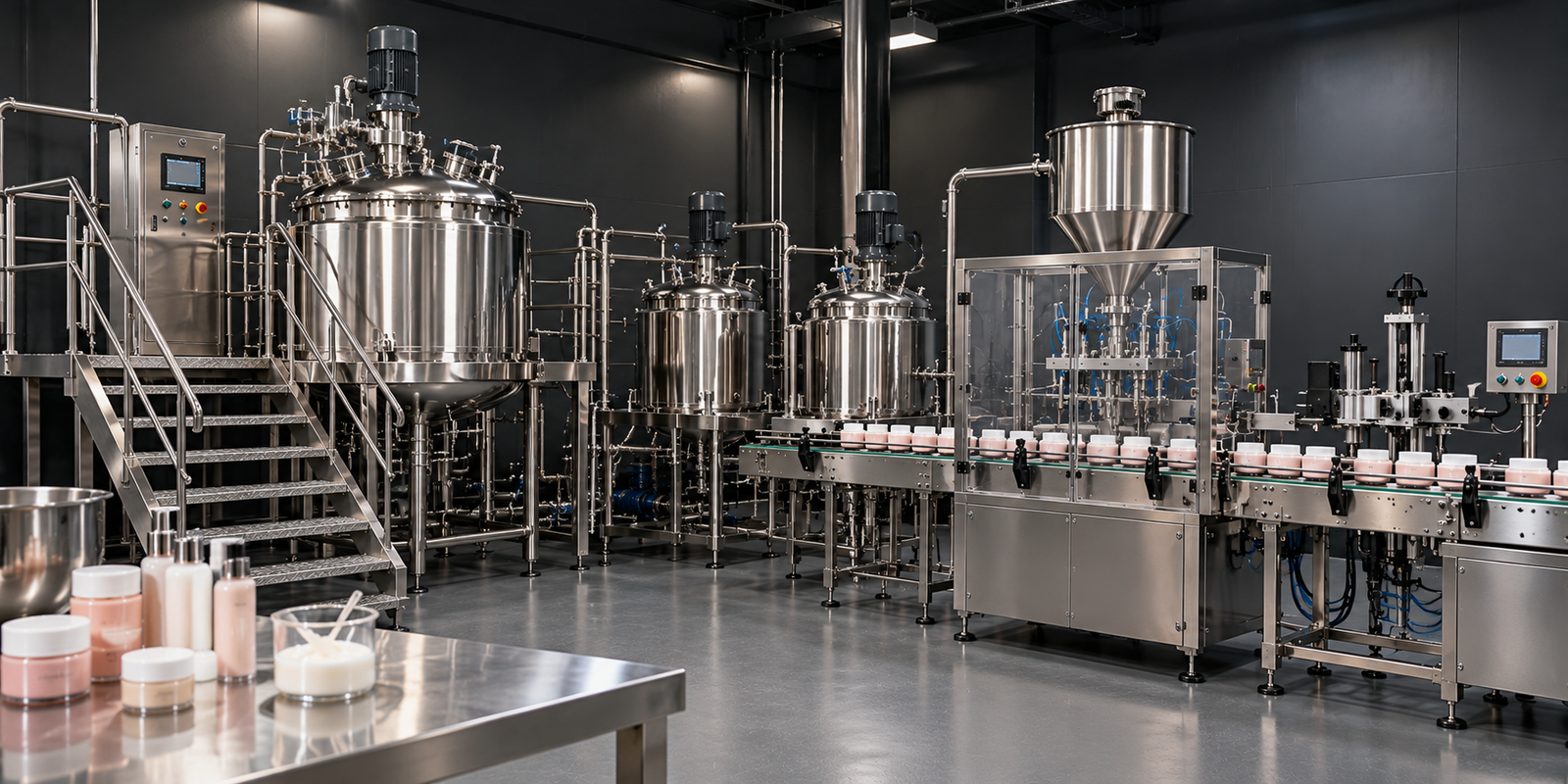
Then comes the manufacturing area, where your cosmetic mixing tank and processing vessels live. For a cosmetic cream manufacturing plant the usual arrangement is one main vacuum emulsifying vessel fed by a water-phase tank and an oil-phase tank. After that, finished bulk sits in holding tanks until quality control clears it, and only then moves to filling, capping, labelling and coding. A small lab for checking pH, viscosity and microbial counts completes the picture. Skip the lab and you're guessing.
If you'd like to see how these zones connect in a complete layout, our cosmetic manufacturing plant page walks through the typical configuration.
Automatic or Semi-Automatic?
An automatic cosmetic manufacturing plant earns its keep when demand is steady and your formulas rarely change. Charging, heating, vacuum, homogenizing and cooling run from a stored recipe, so Friday's batch matches Monday's. Operators spend their time watching, not guessing.
Semi-automatic is the sensible route for start-ups and contract manufacturers who switch formulas often. You spend less up front and keep flexibility.
Here's a piece of advice we repeat constantly: build the room for automation even if you buy semi-automatic equipment. Adding a control panel in year two is easy. Moving drains, pipes and walls is not.
Why Nobody Can Give You One Price
People search for shampoo manufacturing plant cost or cosmetic filling machine price and want a single figure. It doesn't exist, and anyone quoting one without asking questions is guessing.
Capacity is the first driver. A 1,000-litre vessel doesn't cost ten times a 100-litre one, but it isn't far off a multiple either. Material comes next. Product-contact parts in SS 316L cost more than SS 304, but 316L stands up better to salts, acids and active ingredients, and for creams I'd pay the difference every time. Then there's automation, and finally finish quality, because cosmetic-grade welds must be smooth and free of crevices where product can hide.
Filling is its own decision. A simple piston filler for cream jars and a servo-driven multi-head line aren't the same purchase. Give suppliers your container sizes and hourly output target, and you'll get a quote worth comparing.
New Equipment or a Cosmetic Manufacturing Plant for Sale?
Used lines can save money, and some are perfectly fine. Just inspect hard. Look at weld condition, homogenizer seals, whether drawings and material certificates exist, and whether spares are still made. A cheap plant with no paperwork can turn into an expensive licensing headache. New equipment arrives with design documents, test records and installation support, which is what an inspector wants to see.
Installation Is Where Plans Quietly Fall Apart
Cosmetic manufacturing plant installation sounds like the easy bit. It isn't. Floors need to be sealed and sloped to drains. Steam or electric heating, chilled water, compressed air and purified water must reach the right points. And someone should measure the door, because we have seen a vessel that simply wouldn't fit through the entrance.
Our engineers like to review your layout drawing before anything ships. Moving a line on paper costs nothing.
Licences and Standards
In India, cosmetic manufacturing is governed by the Drugs and Cosmetics Act and Rules, and you'll need a manufacturing licence from your state authority. The central regulator, CDSCO, publishes the rules and guidance. Many manufacturers also follow ISO 22716 GMP practices, particularly if they plan to export. Inspectors look at layout, staff movement, cleaning records and batch documentation, so design for them from day one.
Mistakes We See Again and Again
Buying a large vessel for a small launch batch and running it half empty. Forgetting cleaning, so valves and pipe runs trap product and cause contamination. Skipping a lab-scale homogenizer, which would have let them test formulas cheaply. And choosing the lowest quotation, then discovering nobody answers the phone after delivery.
If your range will include medicated creams or balms, our ointment manufacturing plant is built for thicker, heated products and shares a lot of design with cream lines.
Who Builds It Matters
At Anomizer we fabricate the vessels, mixers and process lines ourselves, so the people who quote your job also build it. We handle design, factory testing, installation and operator training. Many of our process vessels, from mixing tanks to jacketed units, are variations on our reaction vessels, adapted for hygienic cosmetic use.
When you compare any cosmetic mixing tank manufacturer or lotion manufacturing plant manufacturer, ask one question: who will be on site when something breaks in month eight? The honest answer tells you more than the price does.
A cosmetic factory is a big project, but it isn't a mysterious one. Know what you'll make, size the plant honestly, respect the regulations and pick a supplier who stays reachable. To talk through your project, send the Anomizer team your product list and target output, and we'll suggest a layout that fits.