


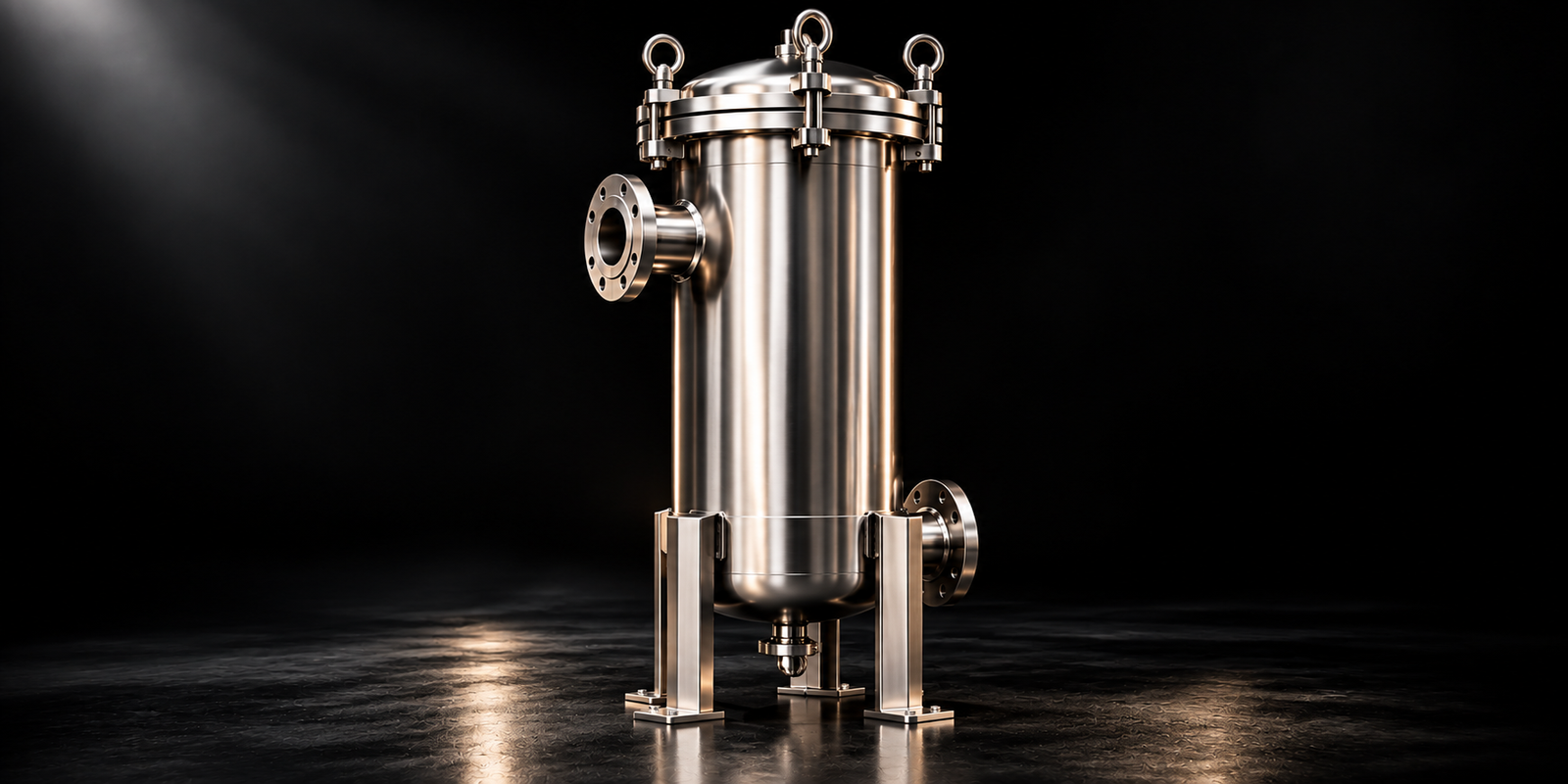
Quick answer: A industrial filter vessel is a pressure-rated housing, usually made of SS 304 or SS 316L, that holds filter cartridges, bags, or candles and forces process liquid through them to remove solids and impurities. It protects pumps, reactors, and finished product from contamination. Anomizer builds stainless steel filter vessels to order, sized to your flow rate, pressure, fluid, and micron requirement.
Where Filter Vessels Are Used
Any plant that has to clean a liquid before the next step needs one. Common users include:
- Pharmaceutical and API units, for solvent and purified water polishing
- Specialty and fine chemical plants, ahead of reactors and packing
- Food, dairy, and beverage lines, for oils, syrups, and juices
- Paint, ink, and coating manufacturers
- Water treatment plants, as pre-RO protection
Each of these asks for something different. A dairy line worries about crevices where bacteria collect. A solvent plant needs vapour-tight closures and compatible seals. A paint unit needs to open and clean the vessel quickly between colours. That is why one catalogue model rarely fits every job.
Why Stainless Steel Is the Standard Material
Most buyers ask for a stainless steel filter vessel, and the reasons are practical. Stainless resists corrosion from most process fluids, survives cleaning chemicals and steam, and gives a smooth internal surface that does not shed particles into your product.
Two grades cover nearly every requirement:
- SS 304 works for water, food-grade duty, and mild chemicals.
- SS 316L is the safer choice when chlorides, acids, or aggressive solvents are present. The molybdenum content improves resistance to pitting.
One habit we recommend: check the chloride level of your cleaning agent, not just the product. In our experience, many corrosion complaints trace back to the CIP chemical rather than the process liquid. An SS filter vessel can also be electropolished to a low roughness value, which helps cleaning validation in regulated industries.
Design Features that Make the Difference
Two tanks may appear identical in terms of design but may be worlds apart when put to use. Here are some important features to consider:
Design pressure and temperature. State the range of operating pressure and temperature conditions, including steam sterilization and pump surges. A tank designed for operating conditions alone is a dangerous option.
Element type and number. Housings can have one or several cartridges and bags depending on flow rate and solids content. The multi-cartridge liquid filter tank provides high filtration capacity within a small footprint.
Sealing materials. Gaskets and O-rings in EPDM, Viton, PTFE, or silicone each have a place. A wrong choice swells or hardens within weeks.
Closure style. Quick-opening clamps suit frequent element changes. Bolted flanged covers suit higher pressures.
Nozzle positions. Bottom inlet and top outlet let air escape during filling. A vent at the high point and a drain at the low point prevent trapped air and product loss.
Weld and surface quality. Internal welds should be ground smooth and pickled. Rough welds hold residue and are usually where corrosion starts.
Codes and testing. Ask whether the design follows a recognised pressure vessel code such as ASME Section VIII, and whether hydro test reports and material certificates come with the vessel.
How to Size a Liquid Filter Vessel
Sizing starts with four inputs: flow rate, viscosity, particle load, and the micron rating needed downstream. A viscous fluid needs more filter area than water at the same flow. A heavy solids load calls for either a larger vessel or a coarse pre-filter, otherwise elements block within days.
Many plants do well with two stages. A coarse stage takes most of the dirt, and a fine stage does the final polishing. The setup costs a little more up front, but the expensive fine cartridge stops doing the heavy work, so consumption drops.
Leave working space too. If operators cannot lift the cover or pull cartridges without disturbing pipework, maintenance gets postponed, and postponed maintenance is where quality problems begin.
What to Look for in a Filter Vessel Manufacturer in India
Prices between fabricators can differ widely, and the gap usually comes from things you cannot see in a quotation. When comparing an industrial filter vessel manufacturer, ask these questions:
- Will you share design calculations and drawings before fabrication?
- Are welders qualified, and are welding procedures documented?
- Can you provide material test certificates traceable to the mill?
- What testing happens before dispatch: hydro test, dye penetrant, surface roughness checks?
- Do you supply spares such as gaskets, cartridges, and cover assemblies later?
- Have you delivered to plants in my industry?
A capable stainless steel filter vessel manufacturer will answer all of these without hesitation. Vague replies tell you something.
India has a strong fabrication base, and working with a local filter vessel manufacturer in India shortens lead times, makes inspection visits easy, and simplifies after-sales support. For a plant that cannot afford a long shutdown, that convenience often matters as much as the purchase price.
Maintenance Habits That Extend Vessel Life
Even a well-built vessel needs routine attention:
- Log differential pressure every shift. A slow rise is normal, a sudden jump is not.
- Change elements by pressure drop, not only by the calendar.
- Replace the cover gasket whenever the vessel is opened for deep cleaning.
- Inspect the internal surface now and then for scratches, discolouration, or pitting.
- Avoid over-tightening closures, since it distorts the seal face.
- Flush and drain before opening, especially with hazardous solvents.
None of this costs much, and it prevents most unplanned stoppages.
Working with Anomizer
We build each industrial filter vessel around the customer's process instead of adjusting a stock design. Before quoting, we ask about the fluid, temperature, cleaning method, and flow rate. Drawings go to you for approval before any metal is cut. This adds a little time at the enquiry stage and saves much more during installation and commissioning.
When you select your vendors, make sure that you provide them with the same data sheet and evaluate their questions rather than the prices alone. The vendor that asks better questions will have been faced with such problems before.
Need an Industrial Filter Vessel for Your Process?
Share your flow rate, operating pressure, fluid type, temperature, and filtration requirement with Anomizer. Our team can help you select a suitable filter vessel for your application.
[Send Your Requirement / Get a Quote]