


Sand filter media manufacturer selection deserves more thought than a quick price comparison, because most filtration problems in a water plant get blamed on the pump, the vessel, or the water itself when the real culprit is usually the bed inside the vessel. A sand bed that was graded badly, washed poorly, or chosen without looking at the raw water will cost you in backwash water, pressure drop, and turbidity that won't go away.
This guide is written from the point of view of a team that builds filtration hardware at Anomizer and sees how media performs once it is inside a working vessel. It covers what good media looks like, how to specify it, and what to ask a supplier before you place an order.
What Sand Filter Media Actually Does
A sand filter works by physical straining and by trapping particles in the depth of the bed. Water enters at the top, moves downward through graded layers, and leaves cleaner at the bottom. Suspended solids, silt, rust flakes, and some organic matter get caught in the gaps between grains.
The quality of that job depends on four things: grain size, uniformity, hardness, and cleanliness. Get any one of them wrong and the bed either lets particles through or clogs within hours.
Water Treatment Sand Filter Media: The Specs That Matter
When you request water treatment sand filter media, you will see a few technical terms on every datasheet. Here is what they mean in practice.
Effective size (ES). This is the grain diameter that 10 percent of the sample passes through. For most pressure sand filters, an effective size of 0.45 to 0.55 mm is a common starting point. Finer sand polishes better but clogs faster.
Uniformity coefficient (UC). A ratio of two sieve sizes. A lower number means grains are closer in size. Aim for a UC of 1.5 or below. High UC means fines sit between larger grains and choke the bed.
Silica content. Good filter sand is mostly quartz, usually above 95 percent silica. Lower purity often brings in soft minerals that break down or leach.
Acid solubility. If the sand dissolves in acid, it can shed material into treated water. Reputable batches show low solubility, typically under 2 percent.
Specific gravity and hardness. Quartz has a specific gravity around 2.65. Harder grains resist the abrasion that backwashing causes over the years.
Ask for a test report on these values with every lot. If a supplier hesitates, that tells you plenty.
Industrial Sand Filter Media Is Not the Same as Swimming Pool Sand
A common mistake is to treat all filter sand as interchangeable. Industrial sand filter media has to handle higher flow rates, harsher backwash cycles, and tougher feed water than a municipal or pool application. Power plants, textile units, pharma utilities, food processors, and cooling water systems each stress the bed differently.
A few examples from typical site conditions:
- Borewell water with iron: Needs media that can be paired with an oxidation step, and a bed that tolerates frequent backwashing.
- Surface water with silt: Benefits from a graded, multi-layer bed so that coarse particles are caught at the top and fines deeper down.
- Cooling tower side-stream filtration: Needs sand that stays stable under continuous duty and warm water.
If your supplier asks nothing about your source water, they are selling a commodity, not a solution.
Graded Layers: Why Support Gravel Matters Too
A sand bed does not sit alone. Below the working sand, most pressure filters need graded gravel layers to hold the sand up and distribute flow evenly across the underdrain. Typical practice uses gravel from about 3 mm up to 40 mm, stacked from fine to coarse toward the bottom.
Skipping or mixing these layers is a quiet cause of channeling. Water finds the path of least resistance, part of the bed does all the work, and filtrate quality drops without any obvious alarm. A serious manufacturer will supply the whole bed schedule, not just the top sand.
Choosing a Sand Filter Media Manufacturer in India
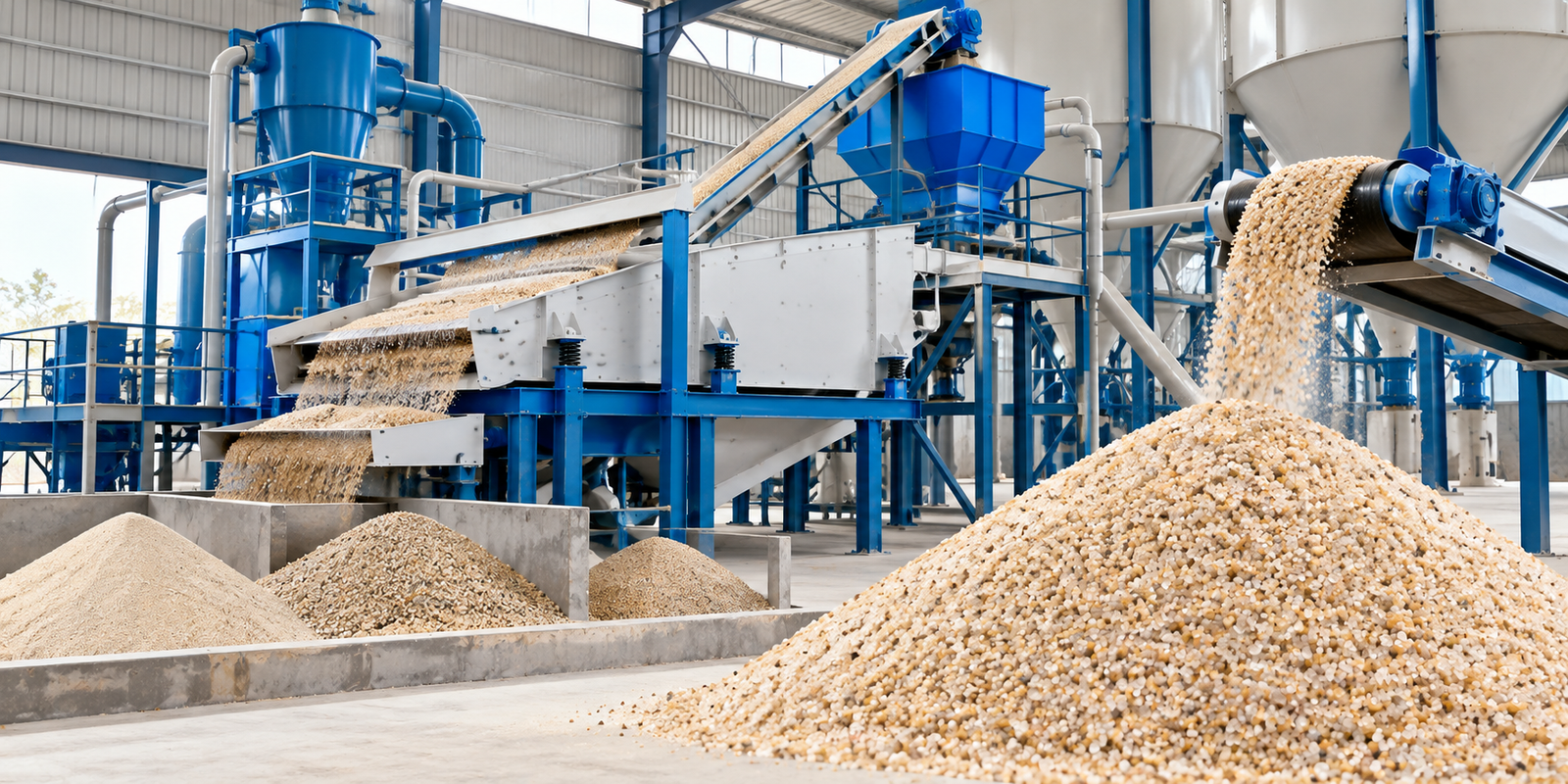
India has a large base of quartz deposits, and that helps buyers. Still, raw quartz is not filter media. It has to be crushed, washed, dried, screened, and graded, and each step shows in the final product. When comparing a sand filter media manufacturer in India, look at these points:
- Source and consistency. Ask where the quartz comes from and whether the source is steady. Batch-to-batch variation is a frequent complaint.
- Washing and drying process. Unwashed sand carries clay and dust that turn the first backwash cloudy and waste water.
- In-house sieve testing. A manufacturer with its own lab can show you a sieve analysis for your exact lot.
- Packaging. Moisture-proof, labeled bags with grade and lot number make traceability simple.
- Technical support. The person you speak to should understand vessel sizing, bed depth, and backwash rate.
The same checklist applies when you evaluate a sand filter media supplier in India. A trader can be fine if the source is a verified manufacturer, but you should be able to trace the material back to its origin.
Sand Filter Media Price: What Drives the Number
Buyers often start with the question of sand filter media price, and it is fair to ask. But the quoted rate per kilo or per tonne rarely tells the full story. These factors move it:
- Grade and grain size range (narrow grades cost more to screen)
- Silica purity and washing level
- Order quantity and packing type (bulk bags vs. small sacks)
- Distance to your site and freight terms
- Testing and documentation requirements
A cheaper bag that needs two extra rounds of backwash before it runs clean, or that has to be replaced a year early, is not cheaper. When you compare quotes, compare them against the same size range and the same test parameters. Ask for the quote in writing with the grade stated.
Sand Media for Water Filtration: Sizing the Bed
Bed depth is often set between 600 and 1000 mm for standard pressure sand filters, though it depends on vessel design and application. Filtration velocity for a single-media sand filter usually sits in the range of 8 to 12 m/h, and backwash is typically done at a higher rate to expand the bed by roughly 25 to 40 percent. These are starting figures, not rules. Your vessel maker and media supplier should confirm them against your feed water quality and required outlet turbidity.
When the vessel and media come from partners who talk to each other, commissioning goes faster and fewer surprises appear later.
Practical Tips from the Field
- Load the media in layers and level each one before adding the next.
- Backwash a new bed thoroughly before putting it into service to remove fines.
- Log the pressure drop across the bed in the first week. It becomes your baseline.
- Plan for top-up. A bed loses a small amount of media over time through backwash carry-over.
- Test treated water regularly instead of waiting for a complaint.
Working with Anomizer
At Anomizer, we approach filtration as a system: the vessel, the internals, and the media have to suit each other and suit your water. If you share your source, flow rate, and target outlet quality, we can help you narrow down the right grade, bed schedule, and quantity before you commit to an order.