

A pharmaceutical syrup manufacturing plant lives or dies on small details. A sugar-rich base is sticky, it crystallizes in dead legs, and it holds heat longer than new operators expect. The plant has to handle all of that and still pass a GMP audit, batch after batch. At Anomizer, we design and fabricate these plants for pharmaceutical and nutraceutical units, and this guide explains what to look at before you commit to one.
What the Plant Actually Does
Sugar, purified water, the active ingredient and excipients go in. A uniform, stable, filterable liquid comes out, ready for filling. Between those two points sit several linked stages:
- Sugar dissolving and syrup preparation under controlled heat
- Mixing of actives, preservatives, flavours and colours
- Cooling and holding
- Filtration
- Transfer to the filling and sealing line
Every stage has its own way of going wrong. Overheat the sugar and the syrup darkens and inverts. Under-mix the active and content varies from bottle to bottle. A good design removes those risks on paper, so operators are not fighting them every shift.
Pharmaceutical Syrup Manufacturing Equipment You Will Need
The right pharmaceutical syrup manufacturing equipment depends on your formulation, but most plants share a common core.
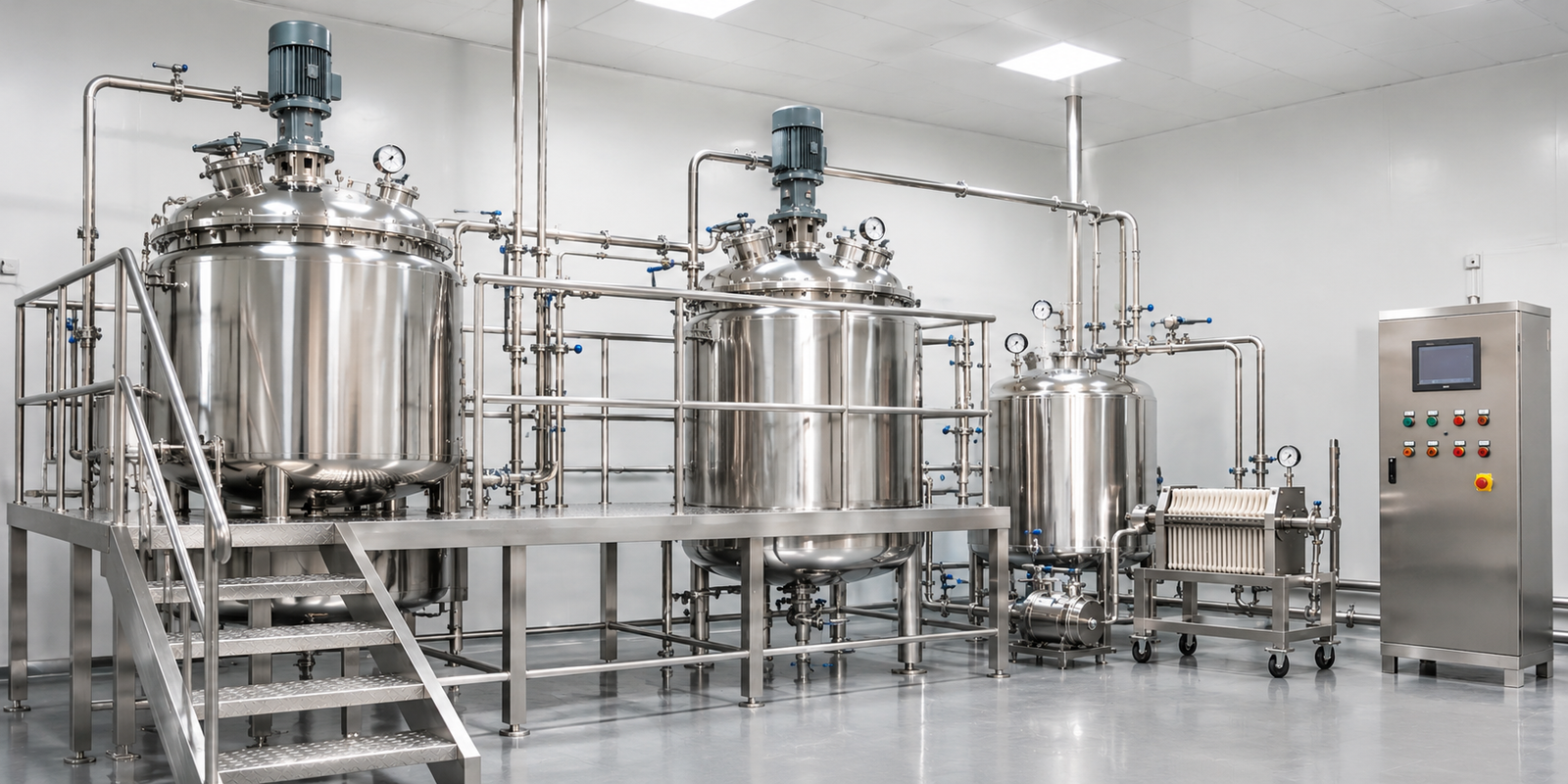
Syrup dissolving vessel. A jacketed stainless steel tank with a slow-speed agitator, heated by steam or hot water. Sugar syrups are thick, so agitator geometry matters more than motor rating. A poorly shaped blade leaves unmixed pockets near the wall.
Manufacturing vessel. This is where the batch is assembled. Product-contact surfaces should be SS 316 with a fine internal finish. Suspension syrups usually need a bottom-entry or side-entry homogenizer as well.
Holding tank. Syrup often has to rest before filtration. Level control and a sanitary outlet keep air out of the product.
Filtration system. A filter press or cartridge housing, which decides the clarity that patients and inspectors both notice.
Transfer pumps and piping. Lobe or sanitary centrifugal pumps with tri-clamp fittings and polished welds. Fewer dead legs means easier cleaning.
Control panel. Anything from push-button operation to a PLC with recipe storage, temperature logging and batch records.
Oral Liquid Manufacturing Plant or Syrup Plant: Is There a Difference?
Buyers often use the terms loosely. An oral liquid manufacturing plant is the broader category, covering syrups, suspensions, solutions and elixirs. A syrup plant is a specific configuration inside it, tuned for high-viscosity, sugar-based products. If you expect to make more than one dosage form on the same line, say so at the start. It changes vessel sizing, agitator choice and cleaning provisions. A liquid oral manufacturing line built for flexibility costs a little more up front and saves a lot of rework later.
Cough syrup deserves its own mention. These formulations often contain several actives, flavour systems and thickeners, and some are alcohol-free or sugar-free. That affects heating, mixing time and filtration. A cough syrup manufacturing plant should therefore be designed around the specific recipe, not copied from a generic layout.
Automatic Syrup Manufacturing Plant: When Does Automation Pay Off?
An automatic syrup manufacturing plant uses a PLC to control heating, agitation, transfer and cycle timing, and it records every batch. For small start-up units running one product, a semi-automatic setup can be perfectly reasonable. Once you run several batches a day, or need electronic batch records for an export audit, automation earns its cost through repeatability and lower labour. It also reduces the operator-to-operator variation that quietly causes rejected batches.
Liquid Syrup Production Line Manufacturer: What to Look For
Searching for a liquid syrup production line manufacturer or a syrup processing plant manufacturer? Check who actually fabricates the equipment. A trader who sources from three workshops can quote attractively, but when a gasket leaks nobody owns the problem. A real manufacturer with in-house fabrication can tell you the shell thickness, weld procedure, jacket design pressure and the reasoning behind an agitator speed. Specific answers show experience. Vague ones do not.
Ask for a sample qualification file too. Design, installation, operational and performance qualification documents (DQ, IQ, OQ, PQ) are not optional if you face a WHO-GMP, Schedule M or export audit. Indian manufacturers can review the current requirements on the CDSCO website before finalising a design.
Syrup Manufacturing Plant Price and Syrup Manufacturing Machine Price
Everyone asks about syrup manufacturing plant price first, and an honest vendor will say it depends. The same goes for syrup manufacturing machine price, which covers individual items such as a vessel or a filter. We would rather explain the drivers than quote a number with no context.
Batch size. A 500-litre setup and a 5,000-litre setup are different projects, not two sizes of one design.
Automation level. Manual valves cost far less than a full PLC system.
Material grade. SS 316 on contact parts costs more than SS 304, and pharma work generally needs 316.
Heating method. Steam-jacketed vessels need a boiler, while hot-water or electric systems have different capital and running costs.
Add-ons. Homogenizer, CIP skid, vacuum transfer, upgraded filtration and an integrated filling line all move the total.
Documentation. Audit-ready paperwork takes engineering time and should be priced in.
When you compare quotes, make sure each covers the same scope. A low figure often leaves out piping, panels or installation. For a quote based on your own batch size and formulation, contact the Anomizer team.
Syrup Manufacturing Plant Turnkey Project and Installation
A syrup manufacturing plant turnkey project means one vendor handles design, fabrication, utilities coordination, installation, commissioning and qualification support. The benefit is single-point responsibility. If something does not fit, there is one party to call instead of three.
Syrup manufacturing plant installation goes smoothly when the site is ready. Steam, power, compressed air and drainage should be in place before the equipment arrives, and the floor layout should leave operators room to reach valves, sampling points and drains. Delays during commissioning almost always trace back to missing utilities, not equipment faults.
Mistakes We See Repeatedly
- Undersizing the heating jacket. The plant works on paper but dissolves sugar too slowly in practice.
- Choosing a pump for water. Viscous sucrose solutions need a pump rated for them.
- Skipping spare parts planning. Seals and gaskets wear out, so know what to keep in stock.
- Treating layout as an afterthought. Plan the floor before fabrication begins.
- Buying on price alone. The cheapest plant rarely stays the cheapest after year one.
How Anomizer Works
We start with your product, not our catalogue. We ask about batch size, formulations, steam availability and target markets. Then we propose a layout and equipment list, fabricate in-house, test the system and support commissioning at your site. Our engineers stay involved through qualification so the paperwork matches what is standing on your floor.
Planning a new line or upgrading an old one? Visit anomizer.com and send us your formulation and target output. We will tell you plainly what fits and what does not.